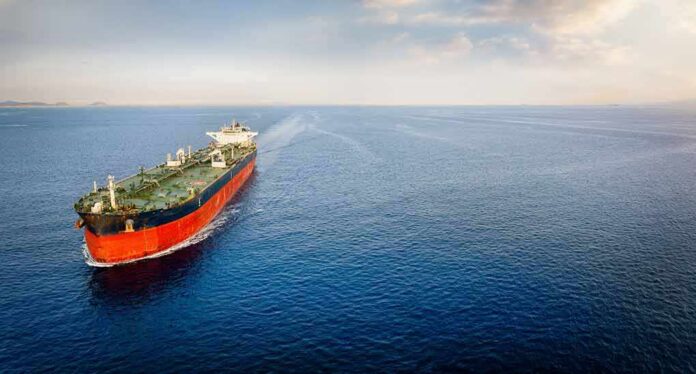
American fighter jets and warships disabled three Iranian-flagged oil tankers in the Gulf of Oman after the ships ignored warnings and tried to break a U.S. blockade against Iran.
Quick Take
- U.S. Central Command (CENTCOM) says forces disabled the tanker M/T Hasna on May 6 after it ignored repeated warnings.
- Two more tankers, M/T Sea Star III and M/T Sevda, were disabled on May 8 with precision strikes on their smokestacks.
- All three ships were headed to Iranian ports in violation of a standing U.S. blockade, according to CENTCOM.
- CENTCOM says none of the three tankers reached Iran after being hit.
- The strikes come amid a wider run of Gulf of Oman ship attacks tied to the ongoing U.S.-Iran conflict.
Navy Jet Disables First Tanker With Cannon Fire
CENTCOM says the trouble started May 6, when American forces spotted the Iranian-flagged tanker M/T Hasna crossing international waters toward an Iranian port. The ship was empty but breaking the U.S. blockade meant to choke off Iran’s oil trade. Forces gave the crew several warnings, and when they refused to stop, an F/A-18 Super Hornet from the aircraft carrier USS Abraham Lincoln fired its 20mm cannon into the tanker’s rudder, disabling it.
Disabling a rudder is not a random act. It stops a ship from steering without sinking it or hurting the crew. That is the kind of restraint conservatives have long demanded from American forces overseas — hit the target, avoid needless bloodshed, and send a message that rules will be enforced.
Two More Ships Hit Two Days Later
CENTCOM says the pressure campaign did not stop there. On May 8, U.S. forces disabled two more Iranian-flagged tankers, M/T Sea Star III and M/T Sevda, just before they could slip into an Iranian port. This time, forces used precision munitions fired straight into the ships’ smokestacks. Reuters and CNBC both reported the Pentagon’s account of the strikes the same day, confirming the tankers were targeted for trying to dodge the blockade.
CENTCOM stated plainly that “all three vessels are no longer transiting to Iran,” a direct claim that the mission worked as planned. For a White House that campaigned on rebuilding deterrence after years of weak responses to Iranian provocations, that is the kind of outcome President Trump’s team wants voters to see: a clear line drawn and enforced without hesitation.
Blockade Enforcement Continues Into Summer
The tanker strikes were not a one-time event. CENTCOM later reported that Marines boarded another Iranian-flagged vessel, the M/T Celestial Sea, in June, suspecting it of trying to break the same blockade. That ship was searched, then released after being ordered to change course. By early June, CENTCOM said it had disabled nine non-compliant ships that week alone, a sign the blockade was being tested constantly by Iranian shipping.
This fits a much larger pattern across the Gulf of Oman and the Strait of Hormuz this year, where tankers have been hit by drones, projectiles, and explosions tied to the broader U.S.-Iran conflict. Reuters has documented a string of separate incidents, including a Palau-flagged tanker hit off Oman in March and two Saudi-linked tankers struck in the Strait of Hormuz in September, showing how dangerous the waterway has become for commercial shipping.
Iran Calls The Strikes An Act Of Aggression
Iran’s government pushed back hard against the U.S. account. Iran’s Foreign Ministry called the American strikes on its tankers an “act of aggression” and described them as “aggressive and provocative actions.” Tehran claimed its own attacks on U.S. destroyers came only after an American strike on an Iranian tanker near Jask and after U.S. forces entered Iranian waters. Iran’s military also warned that ships must stick to Iran-approved routes or face what it called a “rapid and decisive reaction”.
Legal scholars have raised separate questions about what makes a blockade lawful under international rules, noting it must be publicly declared, applied fairly to all nations, and backed by real military force rather than just words. Whatever the legal debate, CENTCOM’s message to Tehran has been consistent all year: ships trying to move Iranian oil through the blockade will be stopped, disabled, and turned back.
What This Means For American Strength
President Trump’s administration has framed the blockade as a tool to cut off Iran’s oil money and weaken its ability to fund regional aggression. Three disabled tankers in a single week sent an unmistakable signal to Tehran and to allies watching how America handles hostile shipping. For conservatives who spent years frustrated by weak enforcement of American red lines, these strikes show a military willing to act decisively rather than issue empty warnings.
For example, an F-35A (F-16/18 replacement) has an empty weight that is approaching 85% of the F-15E strike fighter which in 4th gen terms would be considered a 'heavy'. The F-22A has an empty weight that is 7k+ over the F-15E's. You may be fixating on length which whereas many…
— Air-Power | NatSec Ledger (@NatSecLedger) September 5, 2026
The Gulf of Oman remains a dangerous flashpoint, with tankers from multiple nations caught in the crossfire of an active conflict. As the blockade continues, more encounters between U.S. forces and Iranian-flagged shipping are likely, keeping the region and global oil markets on edge.
Sources:
insiderpaper.com, centcom.mil, engine.online, stripes.com, cnn.com, cnbc.com, aljazeera.com, internazionale.it
© truthandliberty.com 2026. All rights reserved.