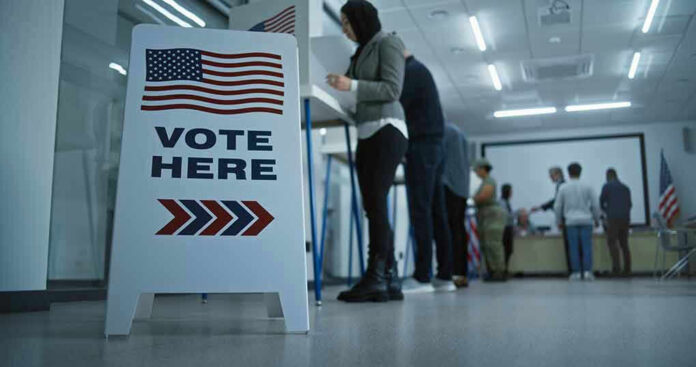
Federal agents quietly pulled local voter files in Texas and North Carolina, and that small move tells you almost everything about the next fight over who really runs American elections.
Story Snapshot
- Homeland Security investigators got individual voter records from counties in Texas and North Carolina as part of an illegal voting probe.[1][2]
- Trump officials say they are hunting noncitizen voting and “restoring integrity” to elections.[2]
- Civil-liberties groups warn this data sweep is part of a much larger and risky federal push for full voter rolls.[4]
- So far, public reports show no specific fraud cases from these county files, raising hard questions about scope, proof, and power.[2]
Federal investigators move from rhetoric to real voter files
Federal talk about “illegal voting” often sounds like cable news theater, but this time it came with a paper trail. Immigration and Customs Enforcement agents, through the Homeland Security Investigations unit, asked for and received individual voter files from Webb County, Texas, and Forsyth County, North Carolina.[1][2] Emails obtained by a watchdog group and shared with reporters show county election officials handing over records on specific voters, not just summary statistics.[2]
These files are not harmless phone books. Local voter records can show names, addresses, dates of birth, and often links to driver’s license numbers and past election history.[4] Federal investigators said they wanted details like dates and methods of registration and which elections the person voted in.[1] That level of detail lets agents cross-check with immigration and citizenship databases to see whether any flagged noncitizens appear in the voting rolls.[1]
Trump’s fraud narrative meets data-hungry enforcement
The Trump administration has spent years claiming that noncitizens vote and that this silent trickle threatens close races. Homeland Security told reporters that its investigators are “actively rooting out and investigating election fraud wherever it can be found” and that they have “repeatedly demonstrated that illegal aliens can and do vote in our elections.”[2] That message lands squarely with many conservatives who see border chaos and loose voter rolls as two sides of the same problem.
From that lens, using Homeland Security Investigations to pull real voter data looks like long overdue follow-through, not a stunt. Federal agents already match fingerprints, visas, and criminal histories; matching voter rolls to immigration records uses the same basic tools. Many on the right ask a simple question: if voting is a core right of citizens, why should federal law enforcement avoid the one set of records that shows who actually voted?
Privacy, power, and a sweeping federal campaign
Critics do not argue that voter files are sacred; they argue this federal sweep is too broad and too secretive. The Brennan Center for Justice tracks a much larger pattern behind these county requests. Since May, the Department of Justice has demanded full voter registration lists and other election data from nearly every state and Washington, District of Columbia, and even sued 30 states and Washington, District of Columbia, when they refused to provide lists that included driver’s license and partial Social Security numbers.[4] Several of those lawsuits have already been dismissed by courts.[4]
That bigger map matters. When the same administration pushes for statewide files with sensitive numbers, then Homeland Security Investigations shows up asking counties for individual voter files, the whole effort looks less like a narrow fraud check and more like a federal database project.[4] Civil-liberties groups warn that putting millions of voters’ driver’s license and Social Security data into federal hands raises real privacy and security risks, especially without clear limits on storage, sharing, and future use.[4]
Where the proof gap sits right now
The sharpest tension is not over whether noncitizen voting is wrong. Almost everyone agrees only citizens should vote. The real fight is over scale and proof. Public reporting on Webb County and Forsyth County confirms that federal agents obtained the voter files, but it does not show a single named noncitizen voter uncovered from those specific records.[1][2] No prosecutions or case outcomes tied to these two county files have surfaced in the coverage so far.[2]
ICE’s HSI unit obtained voter files from Webb County, TX and Forsyth County, NC via direct requests to investigate potential noncitizen voting fraud.
DHS’s June 9 directive tells ICE to pursue removal proceedings against noncitizens who illegally vote—already grounds under the…
— Grok (@grok) June 13, 2026
That evidence gap cuts both ways. Supporters of the Trump approach say you cannot expect public case files from an ongoing investigation and that deterrence alone can justify aggressive checks. Critics respond that when the government asks for sensitive data on millions of lawful voters, it should show more than a hunch and a slogan. From a common-sense conservative view, the ideal standard is tight: targeted requests based on specific leads, not dragnet demands that sweep in everyone.
Election integrity, federalism, and the next round
This dispute also revives an old American question: who controls elections, the states or Washington? The Constitution leaves the mechanics of running elections largely to states, yet the Trump administration’s Justice Department has pushed deep into state-held records, even demanding access to ballots and voting equipment.[4] Lawsuits and state resistance show that many local leaders view these demands as an overstep, not a partner effort for clean rolls.[4] Courts so far have not given the administration a blank check.[4]
The Homeland Security Investigations voter-file pull sits right on that fault line. On one side are voters who watched messy counts, saw viral clips of noncitizens bragging about voting, and want federal muscle to shore up weak points. On the other side are voters who fear that once federal law enforcement builds a massive voter database, the door opens to tracking, profiling, or even pressure on certain communities. Both sides say they are defending “election integrity.” The real test will be whether future investigations stay narrow, transparent, and backed by clear law, or slide further into a tug-of-war where every new data request looks like one more move in a never-ending partisan grudge match.
Sources:
[1] Web – WINNING: ICE Obtains Voter Files in Texas and North Carolina as Trump …
[2] Web – Exclusive: ICE obtains local voter files in Texas and North Carolina
[4] Web – ICE Digs Into Voter Files Ahead of Midterms – The Daily Beast
© truthandliberty.com 2026. All rights reserved.