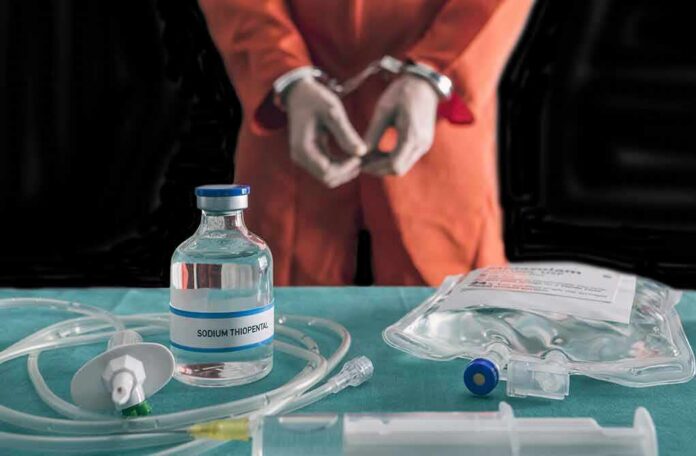
Tennessee strapped a woman to a gurney, injected her with two doses of lethal poison, and she kept breathing.
Quick Take
- Christa Pike survived two doses of the execution drug pentobarbital on September 30 and was rushed to a hospital still alive.
- Governor Bill Lee ordered a full third-party review and paused every remaining execution in Tennessee for the rest of 2026.
- A leading death penalty expert called it the worst botched execution in the modern era, with no real precedent.
- State corrections officials say they followed every step of Tennessee’s approved protocol and that the drug has “consistently been effective.”
Two Doses, No Death
Tennessee tried to execute Christa Pike at Riverbend Maximum Security Institution on September 30, 2026, for a 1995 murder she committed at age 18. After two syringes of pentobarbital, her lawyers said she still had a heartbeat and was “audibly snoring” on the gurney, not unconscious or dead as the drug is supposed to guarantee.
Officials then moved Pike by ambulance to a nearby hospital, where she remained under medical care. That detail alone separates this case from a typical execution, where death is declared on the spot. Reports from the scene describe a process that stretched far past its expected timeline, leaving officials unable to immediately explain what went wrong.
Witnesses Describe an Unprecedented Failure
Robin Maher, executive director of the Death Penalty Information Center, called the event “singular and unparalleled,” adding that what Pike experienced had no real match in modern execution history. Her group tracks these failures nationally, and her blunt assessment carried weight because her organization rarely uses such strong language.
Other observers echoed that alarm. One report quoted Maher calling it “one of the worst botched executions in the modern death penalty era,” noting it came just months after Tennessee also mishandled the planned execution of Tony Carruthers in May. That makes two failures in one state within a single year.
Tennessee Insists Its Rules Were Followed
The Tennessee Department of Correction pushed back hard against the idea that anything went wrong with its process. In a statement, the agency said it “followed every step of the State’s lawful, established execution protocol approved by the Attorney General’s Office,” and insisted the lethal injection chemical “has consistently been effective.”
Before the execution, a special judge had already rejected most of Pike’s legal challenge to the method. He ruled her weak veins would not prevent an IV from being started, and said any prisoner challenging a method must point to a specific, workable alternative that clearly reduces the risk of severe pain.
A Pattern That Predates This Case
Tennessee’s problems did not start with Pike. The Death Penalty Information Center has documented at least 64 botched executions nationwide since 1982, with the overwhelming majority tied to lethal injection rather than other methods like firing squads or the electric chair. That history suggests a structural weakness, not a one-time accident.
🚨 BREAKING NEWS: Tennessee halts executions after Pike survives
Tennessee has halted executions after Christa Pike survived two lethal injection attempts. Pike had been on death row since her 1996 conviction for the murder of Colleen Slemmer. This unprecedented survival event… pic.twitter.com/TrUmz2V3bV
— Globenews (@newsglobeorg) October 1, 2026
Governor Lee’s decision to halt all remaining 2026 executions and order an outside review signals the state itself sees this as more than routine. For Americans across the political spectrum who already distrust how government agencies explain their own failures, a state-run system struggling to carry out its most absolute power raises hard questions about oversight, transparency, and whether officials are leveling with the public.
Sources:
youtube.com, theguardian.com, bbc.co.uk, apnews.com, jamaicaobserver.com, yahoo.com
© truthandliberty.com 2026. All rights reserved.