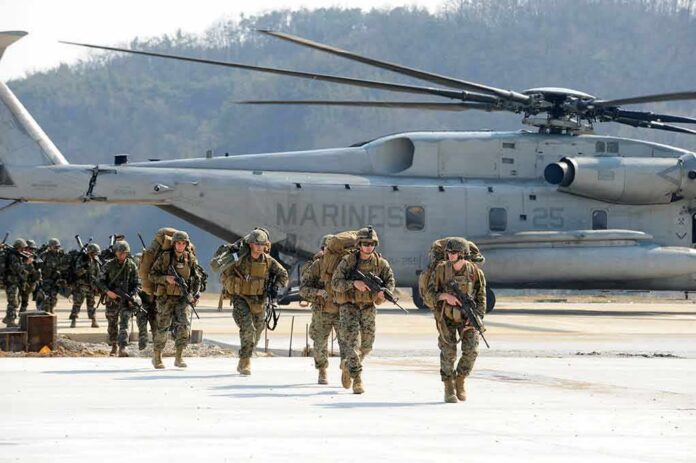
President Trump declared the full U.S. withdrawal from Iraq a decisive victory over the Islamic State group, marking the end of a 12-year mission.
Story Highlights
- President Trump said the Iraq exit is “a victory for the United States” and an orderly end to the anti-ISIS mission.
- The Pentagon said the milestone reflects defeating ISIS as an organized military threat in Iraq and the region.
- Trump said there is no longer a territorial caliphate to fight, so American troops are coming home.
- Some outlets reported concerns that Iran-backed groups could try to exploit the vacuum post-withdrawal.
Trump’s Framing: Mission Accomplished, Troops Home
President Trump told the country the mission ended on U.S. terms and on schedule. He called the departure “a victory for the United States, a victory for Iraq, and a decisive victory over ISIS,” and described the process as orderly and deliberate. He argued the goal was clear and now complete: defeat the ISIS caliphate, then leave. He said, “We came to fight a caliphate, and there is no longer a caliphate, so we are going home”.
The president also linked the exit to fixing past mistakes that drained U.S. lives and treasure. He called Iraq a “quagmire” born of “very bad decision-making,” and said it was “time for America to go home” after a long, costly war that he described as “a very expensive excursion into Hell”. For many readers who value limited government and strong borders, ending open-ended wars aligns with putting Americans and their security first.
Pentagon’s Assessment: Anti-ISIS Mission Concluded
The Pentagon stated the withdrawal capped a 12-year campaign that ended ISIS as an organized military threat in Iraq and across the region. Multiple outlets described the exit as the formal close to the coalition’s anti-ISIS mission, reinforcing that this was a defined endpoint rather than drift or retreat. That framing matters. It signals to allies and foes that America set a target, met it with partners, and then refused mission creep that would keep troops overseas without clear purpose.
Trump emphasized that Iraq now has a new prime minister to lead its own security path, and he praised that leadership as the country assumes more responsibility. Supporters of a strong but focused foreign policy see this as a reset: assist local partners to stand up, then let them stand on their own. That approach reduces the burden on U.S. taxpayers and service members while staying ready to strike terrorists if they reemerge to threaten Americans.
Risks and Realities: Iran-Backed Militias and ISIS Remnants
Major outlets also reported concerns that Iran and its allied militias could try to spin the U.S. exit as their win or seek more sway inside Iraq. Analysts warned that security gaps could appear if Baghdad fails to rein in rogue groups or if ISIS cells look to regroup. Those risks are real and deserve sober attention, but they do not erase the fact that ISIS no longer holds a territorial caliphate, which was the U.S. military’s core target.
"This day is a victory for the United States. It's a victory for Iraq and a decisive victory over ISIS, which has been completely decimated, which is the reason we went in there in the first place. President Trump reacts to the final withdrawal of U.S. troops from Iraq pic.twitter.com/ppIpmIq9KC
— qpatriot (@qpatriot49tr) September 30, 2026
The available public record shows quotes and summaries more than full official documents. That limits outside verification of every phrase or planning detail. Still, the baseline facts are clear: the United States ended the anti-ISIS mission in Iraq, brought the last troops home, and stated that the organized territorial enemy there had been defeated. The next test is whether Iraq’s leaders keep militias in check and protect their citizens without U.S. boots on the ground.
What This Means for American Strength and Priorities
Ending a long deployment frees U.S. forces, funds, and focus for threats that matter most to Americans at home. Securing the border, restoring energy dominance, and rebuilding readiness all benefit when Washington stops writing blank checks for endless overseas missions. If terrorists regroup or threaten Americans, the United States can strike hard from a position of choice, not entanglement. That is deterrence built on clarity: defined goals, decisive force, and the discipline to come home when the job is done.
Sources:
insiderpaper.com, kob.com, nypost.com, nampa.org, gulfnews.com, bostonglobe.com, irishexaminer.com, cnn.com, english.mathrubhumi.com, aa.com.tr, newsbreak.com, kurdistan24.net, sbs.com.au
© truthandliberty.com 2026. All rights reserved.