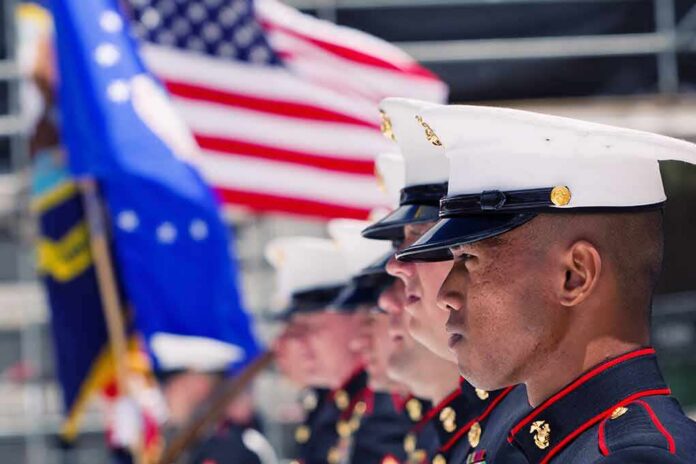
A secret recording from Quantico now exposes Marine leaders mocking their own troops after a third suicide at the same air facility in under two years, raising hard questions about command climate and government accountability.
Story Snapshot
- A leaked closed-door recording captures senior Marines reportedly mocking written complaints after a suicide at Marine Corps Air Facility Quantico.
- The death of Cpl. Drew Mobley was the third suicide tied to the air facility in less than two years, all under official suicide-prevention rules that should protect troops.[1]
- Multiple Marines describe long hours, understaffing, family strain, and leaders who brushed off mental health concerns as weakness.[1][2]
- Marine Corps officials say the case is “under investigation” but have not publicly answered the specific claims in the leak.[1]
Leaked Tape Shows Marines’ Complaints Mocked After Third Suicide
Reports say that in April 2025, after Cpl. Drew Mobley died by suicide, Marines in the Aircraft Rescue and Fire Fighting unit at Marine Corps Air Facility Quantico were called into a secret two-hour meeting with top leaders.[1][2] According to The War Horse, a nonprofit newsroom that obtained the audio, First Sergeant Christopher Rushton read Marines’ written complaints out loud and mocked them, saying, “Oh, master sergeant yelled at me. I’m sad. Boo-the-fuck-hoo. You really think ISIS cares?”[1] He also reportedly told the room, “Call CNN. See how that works out for you,” when Marines raised concerns about leadership.[1] Social media clips from the recording highlight him calling the situation “a f–king mutiny” and branding Marines who spoke up as “disloyal people.”[3][5]
The meeting came after Marines used an internal process to say that leadership ignored warning signs, mocked injury and mental health issues, and kept pressing people to work despite serious stress.[1][2] Rather than calm the unit, the leaked audio suggests commanders focused on shutting down dissent and defending the chain of command. For many conservative readers, this feels backwards: the troops raised their hand and asked for help, and the system they serve answered with scorn instead of accountability.
Pattern of Suicides and Claims of Toxic Command Climate
Cpl. Mobley’s death did not happen in a vacuum. Reporting says it was the third suicide tied to Marine Corps Air Facility Quantico in under two years, including a senior enlisted Marine in August 2023 and another Marine from the same Aircraft Rescue and Fire Fighting unit a few months later.[1][2] While The War Horse was still investigating, yet another former member of that unit reportedly died by suicide in February 2026, deepening concerns about the culture in and around the air facility.[1][2] Six Marines from the unit told reporters they worked long shifts in an understaffed shop, missed time with their families, and felt leaders brushed off their mental health worries as excuses.[1]
One former unit member, Michael Snell, called Mobley’s death “horribly preventable” and said maltreatment “had been going on forever and was getting ignored … by literally everyone in the command.”[1] Another Marine’s written statement, quoted by Mother Jones, claimed Mobley was publicly ridiculed after a major leg injury and placed over and over in a lonely dispatch role, which they said pushed him “too far.”[2] These accounts fit a wider pattern seen in other military suicide cases, where high stress, heavy workloads, and harsh leadership can make it harder for struggling troops to get real help.[3][4] For families who trust that the government will care for their sons and daughters in uniform, this kind of picture is deeply troubling.
Official Suicide-Prevention Promises vs. On-the-Ground Reality
The Marine Corps has a thick, 98-page Suicide Prevention System procedures guide that is supposed to govern how leaders spot warning signs, respond after a crisis, and support units after a death.[1][2] A separate Quantico public article from earlier years promotes training like “Stress First Aid,” tells Marines to “see something, say something,” and urges leaders to connect struggling troops with counselors.[6] On paper, this matches what most conservatives expect from a serious force: strong standards, clear training, and a duty of care to every Marine.
🧵(2/2) – USAF C-17 (TEDDY45) landed in Quantico, VA on 06/06/26 at 6:41 p.m. UTC, with POTUS Helicopter Package.
Departure: Eau Claire Chippewa Valley Regional Airport (KEAU)
Destination: Quantico Marine Corps Air Facility (KNYG)
Reg. 05-5141 | ICAO: AE144B— U.S. Government Jets (@USGovJets) June 8, 2026
The War Horse investigation, however, argues that many of those procedures were pushed aside before and after Mobley’s suicide, pointing to “systemic failures” and an “alarming disregard” of the official rules.[1] Marines in the unit said leaders discouraged medical and mental health appointments during work hours and treated stress as weakness instead of a red flag.[1][2] When asked by reporters, a Marine Corps spokesman said only that the incident is under investigation and no details could be shared, adding a broad statement about how seriously the Corps takes suicide prevention.[1] That answer did not address the words heard on the tape, the workload complaints, or the claim that prevention rules were not followed.
Why This Matters for Accountability, Readiness, and Conservative Values
For many on the right, this story hits core beliefs about duty, limited but honest government, and respect for those who serve. Taxpayers fund a large Pentagon, trust their sons and daughters to it, and expect leaders to follow the rules they write for everyone else. When three suicides strike the same air facility in less than two years and leaked audio suggests leaders mocked instead of listened, it raises serious concerns about whether the bureaucracy is policing itself or hiding behind “ongoing investigation” language.[1][2][8]
At the same time, Quantico’s own public messaging about suicide prevention shows the Corps knows what good leadership should look like, including early intervention and real listening.[6] The gap between that message and what Marines say happened in this unit is where Congress, inspectors general, and the public need clear answers. Conservative readers who back a strong military can still demand better: full release of the investigation when finished, transparent review of suicide-prevention compliance, and protection for whistleblowers who speak up when command culture drifts from mission focus to fear and intimidation.
Sources:
[1] Web – Leaked Recording Raises Questions After Third Suicide at Quantico Air …
[2] Web – Secret Tape: Marines’ Claim Toxic Leadership Led to a Suicide
[3] Web – Secret Recording Exposes Claims of Toxic Leadership After a …
[4] Web – “Those are the things I have to live with for the rest of my life,” …
[6] Web – In April 2025, members of the Aircraft Rescue and Fire Fighting unit …
[8] Web – “Who knows what was going on?” Marine 1st Sgt. Christopher …
© truthandliberty.com 2026. All rights reserved.