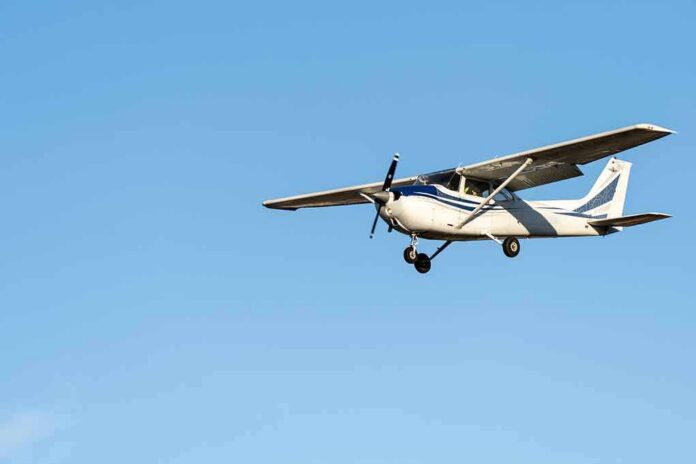
A 38-year-old Alaska mother died after stepping from her vehicle and into a running plane’s propeller at Big Lake Airport, a sequence officials described as an accident based on early findings.
Story Snapshot
- Alaska State Troopers say the plane had stopped when the woman approached it.
- First responders tried lifesaving aid, but she died at the scene.
- Reports identify the aircraft as a Taylorcraft F19 and the victim as from Wasilla.
- Authorities notified federal safety officials and continued to review what led to her approach.
What Officials Say Happened on the Taxiway
Alaska State Troopers reported that the pilot halted a Taylorcraft F19 on the taxiway at Big Lake Airport on November 24, 2026, while a vehicle sat ahead. Troopers said the driver, a 38-year-old woman from Wasilla, stepped out, walked toward the idling aircraft, and contacted the spinning propeller. The aircraft was stationary during the approach. The initial account categorized the event as accidental based on early assessment of the scene and sequence shared with local media.
Multiple outlets relayed the core facts, including the woman’s age, home city, and the aircraft type. Reports describe a sudden, traumatic event with immediate response by local first responders. Medics attempted lifesaving measures, but she was declared dead at the airport. Those details match emergency protocols that follow a severe propeller strike and help explain why officials initially treated the death as an accident pending further review of the circumstances.
Who Responded and What Comes Next
Troopers said first responders arrived quickly and attempted care at the scene. Local reporting states that investigators documented the site and notified federal safety officials. Outlets noted that the National Transportation Safety Board was alerted, though no federal findings were released at that time. The pilot’s detailed statement was not published in full in these reports. Authorities continued to examine why the woman left her vehicle and approached the stationary but running aircraft.
Reporters cited the Alaska State Troopers account in describing the aircraft’s status, the woman’s movements, and the response by medics and law enforcement. That shared narrative established a consistent timeline across stories. While officials labeled the event accidental in early summaries, they did not publish toxicology, autopsy, or a full investigative file in the reports cited. Newsrooms emphasized the basic facts and noted the official notification to federal investigators.
Why Propeller Hazards Persist at Small Airports
General aviation groups and federal researchers have long warned about propeller danger. Older and light aircraft often taxi with limited forward visibility and high noise, which can mask warnings. Historic reviews by the Federal Aviation Administration found more than one hundred propeller-to-person accidents in the 1980s, and other studies logged similar incidents over later decades. These reports show the risk is uncommon but persistent, and it can be deadly in seconds when people are near a running propeller.
38-Year-Old Woman Killed After Walking into Aircraft Propeller at Big Lake Airport, Alaska
Christina Blake, 38, of Wasilla, Alaska, was killed on November 24, 2026, after walking into the rotating propeller of a float-equipped Taylorcraft F-19 Sportsman, N3678T, at Big Lake… pic.twitter.com/0meOUKoAod
— ASX Research 🇺🇸 🇵🇭 (@AviationSafetyX) November 26, 2026
Safety groups advise simple steps that save lives. Pilots are urged to shut down when unsure about people or vehicles near the propeller arc. Ground signs and brief warnings help visitors understand where it is unsafe to walk. Families and bystanders should stay inside vehicles or well clear until guided by a pilot or ground crew. The Big Lake tragedy underscores these basics and why small lapses around moving propellers carry extreme risk, even when an aircraft is not rolling.
Sources:
people.com, news.com.au, kyuk.org, themirror.com, the-independent.com, alaskanews.com
© truthandliberty.com 2026. All rights reserved.