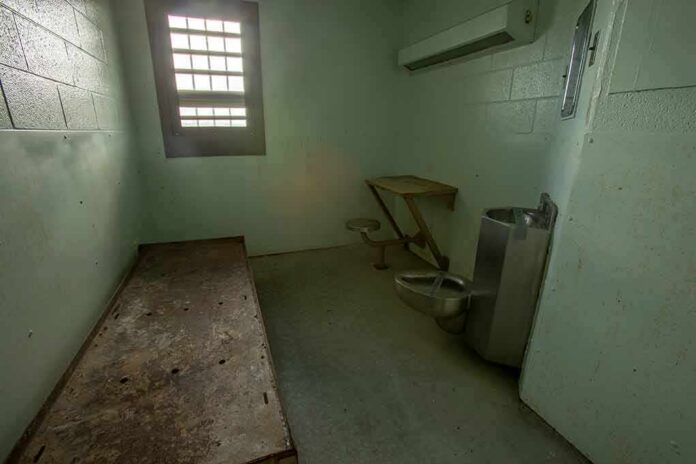
Military lawyers cited a TV interview to keep an Air Force major isolated up to 22 hours a day, exposing a clash between free speech, military order, and basic due process.
Story Snapshot
- Air Force Major Jason Watson is confined alone most of the day while awaiting trial, described as solitary by his defense.
- The Air Force says his housing is administrative protective segregation, not punishment, to follow policy at a civilian jail.
- Government attorneys used Watson’s CNN interview to argue for continued restrictive confinement.
- The core legal test is whether conditions are harsher than needed for safety and appearance at trial, not what they are called.
What Triggered the Case and Why It Matters Now
Reports say Major Jason Watson criticized President Trump on several occasions, including a televised interview in August, a uniformed protest in July, and prior online comments. The Air Force charged him under military law and placed him in pretrial confinement. Defense counsel and multiple outlets say he has spent about 20 to 22 hours per day alone in a cell at a Maryland jail while awaiting a general court-martial, which they call solitary confinement.
The Department of the Air Force rejects the “solitary” label and says Watson is in administrative protective segregation. Officials say a Memorandum of Agreement with the Calvert County Detention Center governs housing and requires separation from civilian inmates to meet military policy and law. The Air Force frames the isolation as classification and compliance, not punishment tied to his speech or charges.
How the CNN Interview Became a Legal Flashpoint
Government attorneys pointed to Watson’s CNN appearance as serious misconduct under military rules. They argued that continued confinement was needed so he would not repeat similar public statements. The Intercept reported that the Air Force said the interview showed probable cause of continued misconduct. This use of a media interview to argue for ongoing restrictive housing brought speech, discipline, and risk standards into the same debate.
Defense sources counter that the orders Watson was accused of violating had expired before the August interview, which would undercut the theory that he defied a standing order. That claim comes from proponent materials and has not been confirmed by publicly available orders or court rulings. The gap highlights a records problem: key documents, such as signed orders and jail logs, are not in the public domain for independent review.
Conditions Versus Labels Under Military Law
Military law bans pretrial punishment and any conditions that are more harsh than needed to ensure a service member’s presence at trial. Judges can grant credit for time spent under unusually severe conditions, even if officials describe those conditions as administrative or protective. In past cases, courts have looked past labels to the actual day-to-day reality when deciding if a command abused its discretion.
This standard is central here. If separation from civilians is required, officials must still show that specific limits, like hours locked in a cell, are not more restrictive than needed. Without public access to confinement reviews, housing alternatives, and risk assessments, it is hard for outsiders to judge whether isolation was the least restrictive option available at the time.
What Remains Unclear and Why People Across Politics Care
Several reported details about cell lighting, temperature, recreation time, weight loss, and search practices rely on lawyer accounts and media summaries rather than jail or medical records. The Air Force confirms confinement and the protective-segregation status but has not released fine-grained logs that would settle these points. That information gap feeds concern on both the right and the left about government opacity and unequal treatment.
US Air Force Major Jason Watson held in solitary confinement just for verbally opposing Trump.#DictatorsHandBook https://t.co/aPDjXMS5Ma
— Papillon Politics 🦋🌏🦋 (@PapillonPo35311) November 21, 2026
Conservatives who value order ask why a nonviolent officer is isolated in a civilian jail. Liberals who fear repression ask why speech appears linked to confinement. Many Americans see a bigger problem: institutions defend labels while people face harsh realities behind closed doors. The test in this case is simple to state and hard to prove: were the strict conditions truly necessary, day by day, to manage real risks, or did bureaucracy and politics push past what the law allows?
Sources:
theintercept.com, nhpr.org, presstv.co.uk, stripes.com, wegotthiscovered.com, knewz.com
© truthandliberty.com 2026. All rights reserved.