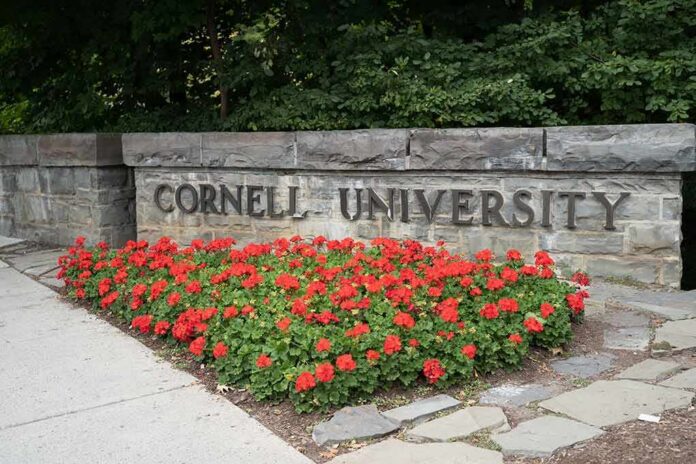
Cornell halted all fraternity-house parties for the entire school year after a lawsuit alleged a 2024 drugging and gang rape inside a Chi Phi house.
Story Snapshot
- Cornell suspended all Interfraternity Council house social events for 2026-27
- A former student alleges she was drugged and gang raped in 2024 at a Chi Phi house
- New York prosecutors reopened the case; a grand jury review is planned
- Defense lawyers deny the claims; Cornell says expulsions and suspensions followed prior hearings
Campus Ban Follows Lawsuit And Renewed Scrutiny
Cornell University suspended all parties and social events in Interfraternity Council houses for the rest of the 2026-27 academic year. The move came after a civil lawsuit alleged a 2024 drugging and gang rape inside the Chi Phi fraternity house. Cornell’s statement said any chapter that hosts an in-house social event will face immediate emergency suspension. The step is sweeping. It targets the setting, not only the named chapter, and signals leaders see party environments as a core safety risk.
The lawsuit filed by a former student, identified as Jane Doe, sparked renewed reviews by law enforcement and state officials. Prosecutors in New York reopened the criminal investigation and plan to bring the case to a grand jury to assess possible charges. National outlets reported the revived probe and broader questions about university responses to sexual assault. The case has reignited debate over campus party culture and whether fraternities can host safe events under current norms.
What The Parties Say About Responsibility And Process
The complaint names Cornell, the Chi Phi chapter, and seven fraternity members. The Cornell Daily Sun reported the defendants’ names from court filings. Cornell said it took disciplinary action after earlier internal processes, and it pushed back on claims that essays were the only consequence. A university official said expulsions and suspensions were issued after a hearing, though the school did not list specific names tied to those outcomes. These points show tension between campus discipline and criminal standards.
Defense attorneys for at least two named defendants deny wrongdoing. One lawyer said his client did not engage in sexual activity and did not touch the plaintiff, challenging the claim head-on. Another defense attorney argued that group messages were crude but were not proof of assault. These statements preview a sharp legal fight. They also explain why some observers want grand jurors, not campus panels, to decide what evidence meets the high bar for charges.
Why Cornell Reached For A System-Wide Ban
Cornell’s order treats the party setting as the shared risk, not just one house. Research shows sexual assault is a problem across campuses, with or without Greek life. The risk often rises where young people mix heavy drinking, peer pressure, and male-controlled venues. Analysts describe assaults as emerging from the social setting as much as from individuals. That frame helps explain why leaders paused all Interfraternity Council house events while the case and policies are reviewed.
An email from #Cornell President Michael Kotlikoff states that all parties and social events in Inter-fraternity Council (IFC) houses are suspended for the rest of the 2026-2027 academic year.
Any fraternity violating this will receive "an immediate emergency suspension."
— Christine Savino (@SavinoChristine) October 13, 2026
Many Americans on both left and right see a pattern in slow or uneven institutional responses. Families worry schools protect brands first and students second. Alumni question whether universities outsource safety to student groups with little oversight. Students ask why it takes a lawsuit to spark action. Those concerns span politics. They echo larger doubts about elite institutions that seem quick to issue statements but slow to fix systems that keep failing people.
What Comes Next For Students And Safety
In the short term, the ban reorders social life. Chapters lose key activities. Students who feel safer may welcome the pause. Others will shift parties off campus, where oversight is weaker. That tradeoff is real. Effective prevention likely requires sober monitors, clear consent education, secure transport, and fast reporting channels. A grand jury review will weigh evidence for possible charges. Campus leaders will be judged by whether they match bold words with day-to-day safeguards that work.
Sources:
insiderpaper.com, cnn.com, cornellsun.com, people.com, bbc.com, academic.oup.com
© truthandliberty.com 2026. All rights reserved.