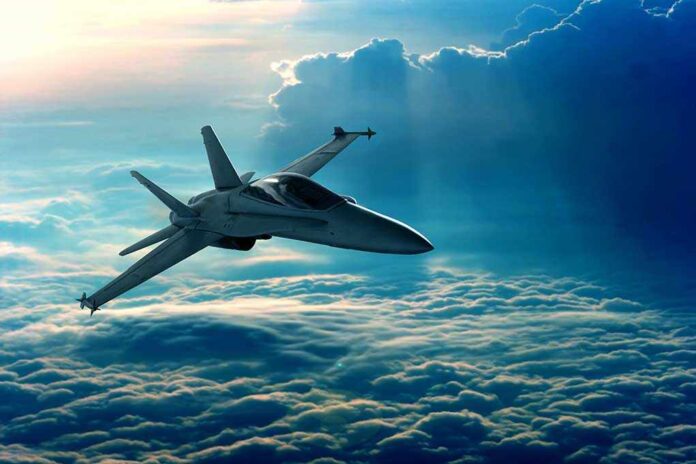
China’s J-10C fighter jet has been photographed carrying what appears to be the YJ-21E anti-ship ballistic missile, marking a potential game-changing development in naval warfare capabilities.
Story Snapshot
- J-10C fighter spotted with YJ-21E anti-ship ballistic missile in first documented sighting
- YJ-21E represents a smaller, fighter-optimized variant of China’s larger YJ-21/KD-21 missile system
- Development signals China’s push to equip smaller platforms with advanced anti-ship capabilities
- Fighter-mounted ballistic missiles could reshape naval engagement strategies in contested waters
Fighter Jets Enter the Ballistic Missile Game
The emergence of ballistic missiles on fighter aircraft represents a significant tactical evolution. Traditional anti-ship missiles follow predictable flight paths, allowing naval defense systems time to intercept them. Ballistic missiles, however, follow high-arcing trajectories before diving onto targets at extreme velocities, making interception far more challenging for existing ship-based defense systems.
The YJ-21E appears specifically engineered for fighter platforms like the J-10C, suggesting Chinese engineers have overcome the substantial technical hurdles of miniaturizing ballistic missile technology. Weight, size, and launch stress considerations typically limit fighter aircraft to conventional cruise missiles, making this development particularly noteworthy from an engineering perspective.
Strategic Implications for Naval Operations
China’s decision to arm the J-10C with anti-ship ballistic missiles reflects broader strategic priorities in contested maritime regions. The South China Sea and Taiwan Strait present scenarios where fighter-launched ballistic missiles could prove decisive. Unlike bombers, which require extensive support and present large radar signatures, fighters can operate more independently and penetrate closer to target areas.
The combination of the J-10C’s maneuverability and the YJ-21E’s ballistic trajectory creates complex defensive challenges for naval forces. Ship commanders must now account for threats arriving from multiple vectors simultaneously, potentially overwhelming point defense systems designed primarily for conventional missile threats.
Technical Evolution from Bomber to Fighter Platform
The YJ-21E’s development from its larger H-6K bomber-carried predecessor demonstrates China’s systematic approach to weapons proliferation across multiple platforms. The H-6K bomber version, designated YJ-21 or KD-21, established the fundamental ballistic anti-ship concept. Adapting this technology for fighter aircraft required significant miniaturization while maintaining terminal effectiveness.
This platform diversification strategy multiplies deployment options while complicating enemy defensive planning. Naval forces must now prepare for ballistic missile attacks from both heavy bombers operating at standoff distances and nimble fighters capable of approaching from unexpected directions. The technical achievement suggests Chinese military industries have mastered the complex engineering required to scale ballistic missile technology across different aircraft types.