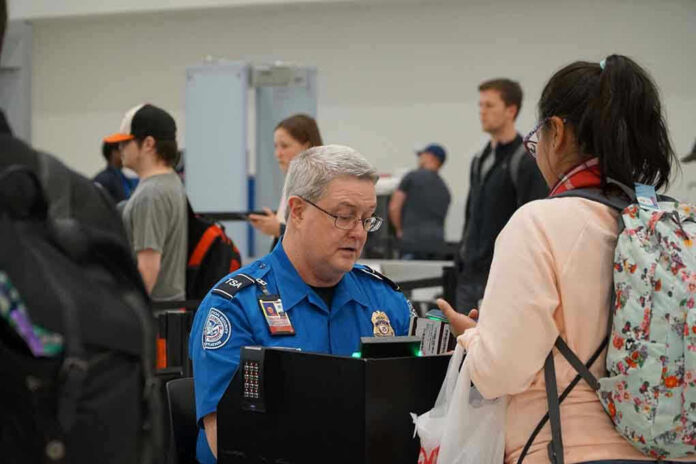
Washington’s latest shutdown chaos proved one thing fast: when Congress won’t do its basic job, Americans end up paying for it at the airport security line.
Story Snapshot
- President Trump signed an executive order on March 27 to repurpose funds and get TSA agents paid during the Department of Homeland Security (DHS) funding lapse.
- DHS Secretary Mark Wayne Mullen said paychecks could arrive as soon as Monday or Tuesday, aiming to reverse staffing shortages and reduce long airport lines.
- Major airports urged travelers to arrive 2–3 hours early even as wait times began easing, signaling only partial stabilization.
- The Senate approved a DHS funding bill, but House Republicans rejected it, leaving broader DHS functions unresolved even if TSA pay is restored.
Trump’s Executive Order Targets TSA Pay as Airport Delays Build
President Donald Trump moved on March 27 to address growing airport disruptions tied to the DHS funding impasse, signing an executive order that repurposes existing funds to pay TSA personnel. Reporting described the approach as shifting money with a “reasonable and logical nexus” to TSA operations. The immediate goal is practical: get agents back on the job, reduce call-outs, and stop the ripple effect of missed flights and gridlock at security checkpoints.
DHS Secretary Mark Wayne Mullen, speaking the next day, said the department’s plan was to get pay out “hopefully by tomorrow or Tuesday,” emphasizing that employees were struggling financially. That timeline matters because the operational breakdown was already visible. The same reporting cited up to 40% call-outs in some locations and roughly 500 agents absent, a level of attrition that predictably slows screening and increases pressure on remaining staff.
Congressional Gridlock Leaves DHS Functions in Limbo Beyond TSA
The partial fix also underscores a broader problem: the executive branch is patching holes while Congress fights over the basics. The Senate approved a DHS funding bill late March 27 that would have covered agencies including TSA, FEMA, and the Coast Guard. House Republicans, however, rejected that Senate-passed measure as a “joke,” leaving the shutdown conditions intact even as the administration searched for ways to prevent a public-facing breakdown at airports.
That split outcome is important for readers who are tired of Washington gamesmanship. A TSA paycheck helps working families and keeps airports moving, but it does not automatically restore full DHS operations or remove uncertainty for other workers and mission areas. The reporting emphasized that wait times were expected to ease, yet airports still warned travelers to arrive two to three hours early. That warning signals the system was not back to normal overnight.
What the TSA “Workaround” Means for Executive Power and the Budget Process
The executive order approach raises an unavoidable constitutional tension: Congress controls the purse, and repeated budget standoffs increasingly invite unilateral executive action to keep critical functions running. The reporting framed the repurposing as legally tethered to related DHS purposes, but the underlying issue remains that shutdowns create pressure for end-runs around the normal appropriations process. For conservatives who want limited government and predictable rule-of-law budgeting, that is a warning light.
Travelers Get Relief, But the Worker-and-Family Reality Drove the Crisis
Airport disruptions weren’t just about inconvenience; they were about household economics. The same coverage highlighted TSA employees dealing with rent and food pressures, a predictable outcome when pay is interrupted. Travelers interviewed described the plan as good news because it supports agents’ families and helps people get back to work. When staffing collapses, the public sees it in long lines, but the cause is often personal finances pushing workers to call out.
Bottom Line: A Short-Term Fix That Doesn’t Replace a Real Funding Deal
As of March 29, the situation was improving but not resolved. The administration’s plan aimed to restore pay quickly and reduce absenteeism, which should shorten lines and stabilize air travel into early April. At the same time, the reporting stressed that the broader DHS shutdown problems remained, with no compromise in sight. The most honest takeaway is that travelers may get faster screenings soon, but Washington still hasn’t fixed the engine causing these breakdowns.
Dems Outfoxed Again: Airports Returning to Normal As Trump Finds Way to Pay TSA Agentshttps://t.co/WxjwXMSPqT
— RedState (@RedState) March 30, 2026
Limited research was available beyond a single, timely report and related social posts, so some claims—such as the exact scale of call-outs across the system and the durability of the funding workaround—cannot be independently verified here. What is clear is the pattern: appropriations standoffs hit working Americans first, and executive improvisation becomes the substitute for a Congress that should have passed a clean, accountable funding solution in the first place.