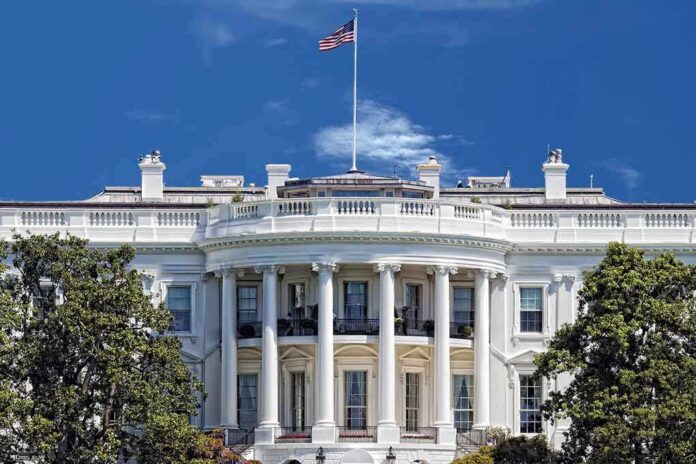
A new White House ballroom is being sold as the main event, but President Trump says it’s basically a “shed” for something far more serious underground.
Quick Take
- Trump says the U.S. military is building a “massive” or “big” complex beneath the new White House State Ballroom.
- The above-ground ballroom is pitched as a security-hardened venue with bulletproof glass and drone-proof protections.
- Trump claims private donors and personal funds cover the cost, with “not one dime” from taxpayers.
- The East Wing demolition and a court fight set the stage for a fast-tracked rebuild tied to national security.
Trump’s “Shed” Comment Changes What the Project Means
President Trump’s March 29, 2026 remarks aboard Air Force One reframed the White House ballroom story from architecture and entertaining to continuity-of-government. He described the new State Ballroom as a surface structure over a much larger underground build led by the military. That one detail matters because it signals the real purpose may be resilience, command capability, and protection—functions the public rarely sees, but always pays for in one way or another.
Trump also emphasized two selling points that land with voters who dislike Washington’s blank checks: private funding and tangible security. He said donors and he personally cover the roughly $400 million project, and he talked up defenses like bulletproof glass and drone-proofing. Those claims don’t reveal classified specifics, but they do reveal intent: this isn’t just about hosting larger dinners; it’s about hardening the seat of executive power for the threats modern America actually faces.
How a Ballroom Became a National Security Story
The East Wing space has long carried more weight than tourists realize. Built in 1942, it included offices and the Presidential Emergency Operations Center, the kind of facility Americans hope never gets used. In this project, demolition of the East Wing in October 2025 cleared the site, and the older emergency infrastructure reportedly got dismantled to make room for a new below-grade facility. Trump later confirmed military involvement, and officials have framed subterranean details as top secret.
Timelines matter because they show intent and momentum. Plans surfaced in summer 2025, site preparation began in September, and by December the construction photos suggested real progress. Cost estimates also moved, from earlier figures to around $400 million. Meanwhile, the ballroom’s planned capacity kept expanding—numbers floated from 650 to 900, then up to 999. Larger capacity sounds like a party detail, but it also signals a stronger political goal: a modernized, high-visibility venue that can host big diplomatic moments.
The Legal Fight Revealed What Government Will and Won’t Explain
The courtroom chapter explains the silence. A Justice Department filing cited national security to support continued construction, and a federal judge ultimately allowed the work to proceed in late February 2026 after questioning authority issues. That sequence tells readers something practical: when projects touch presidential security, the government fights disclosure hard, and courts often defer once national security gets invoked with even modest supporting detail. Americans don’t have to like that pattern to recognize it.
Conservatives should separate two debates that get mashed together on cable news: oversight and operational secrecy. Classified design details for a protective underground facility should stay classified. Funding mechanisms, contractor selection, and donor transparency live in a different category. When the project’s defenders emphasize “no taxpayer money,” they aim to shut down the usual spending criticism. Common sense says the public still deserves clarity about who pays, what influence donors might gain, and what guardrails prevent a precedent of private money steering federal infrastructure.
Private Donors, Public Prestige, and the Influence Question
Trump’s pitch rests on a clean contrast: donors pay, taxpayers don’t. That message resonates because it speaks to the everyday frustration of Americans who feel they fund government programs that never finish on time. The unresolved issue is not whether philanthropy can support public projects—it can—but whether the country should accept a model where major government-adjacent construction proceeds with limited congressional friction because private dollars soften the political cost. Prestige is a powerful currency in Washington, even when no law gets broken.
The donor angle also creates a practical enforcement problem: influence is hard to measure when donation amounts go undisclosed. Even if every donor acts in good faith, the appearance of buy-in to a legacy-defining White House project invites questions that conservatives usually ask first: Who benefits, who decides, and who is accountable when costs rise? The reported shift in estimates over time makes that accountability question sharper. A project can be “under budget” relative to its latest target and still be much costlier than early expectations.
What Bulletproof Glass and Drone-Proofing Signal About the Era
Bulletproof glass and drone-proofing are not decorative details; they admit the threat environment has changed. Drones have become cheap, ubiquitous, and easy to weaponize or use for surveillance. The White House already operates under layered defenses, but public talk of drone-proofing suggests new construction integrates counter-drone concepts rather than bolting them on later. That approach reflects modern security doctrine: design buildings to reduce vulnerabilities from the start, especially when the location can’t relocate and can’t hide.
The “ballroom as shed” line also makes architectural sense in a security mindset. Above-ground structures can serve ceremonial purposes while disguising the scale and access points of a hardened underground footprint. That doesn’t mean the public should assume anything sinister; it means planners build redundancy. Continuity-of-government facilities, by definition, trade visibility for survivability. Americans who value order and stability should understand the logic, even while insisting on lawful process and responsible spending.
The Political Legacy Play Meets a Real Security Need
Trump’s project blends two instincts: the showman’s desire for a grand venue and the commander’s desire for protection. Those motives can coexist. The White House has always evolved—sometimes controversially—when presidents believed the moment demanded it. The real test won’t be how gold the chandeliers look; it will be whether the project strengthens the presidency as an institution instead of personalizing it. A security upgrade that outlasts any one president aligns with conservative respect for durable institutions.
For readers over 40, the deeper takeaway is simple and unsettling: the government expects tomorrow’s threats to look less like foreign armies and more like fast, asymmetric attacks that punish predictability. The State Ballroom headlines pull attention upward, toward glass and guest lists. The underground “massive complex” pulls attention downward, toward continuity, command, and survival. That’s the part you never tour—and the part future presidents will thank or curse depending on how honest today’s decision-makers were.
Sources:
Trump claims donor-funded White House ballroom includes hidden build below, security focus
US military building ‘big complex’ under White House ballroom: Trump