Robert F. Kennedy Jr. told a Michigan crowd that 500 million Arabs “don’t produce science,” a sweeping claim quickly debunked and condemned, turning one man’s rhetoric into a test of whether facts or outrage steer our politics.
Story Snapshot
- Kennedy’s Grand Rapids remarks sparked swift backlash and fact-checks.
- Critics cited Arab Nobel and Wolf Prize winners that contradict his claim.
- The Council on American-Islamic Relations demanded Kennedy’s removal.
- The dispute highlights how broad labels blur religion, ethnicity, and ideology.
What Kennedy Said On Stage In Michigan
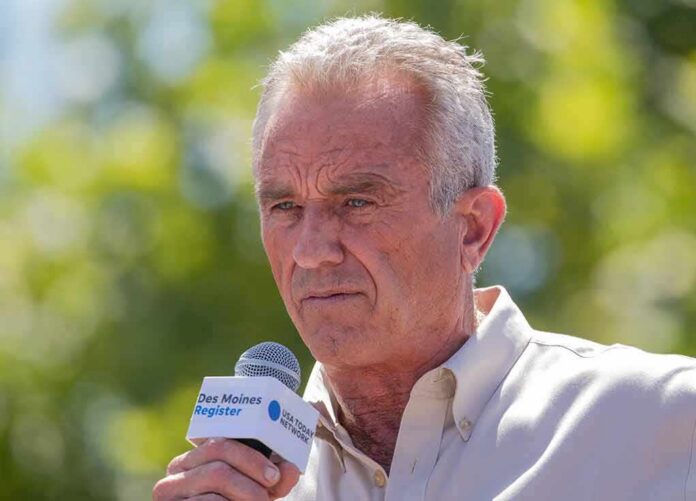
At a Grand Rapids event, Kennedy contrasted a past Islamic “golden age” with what he called modern stagnation. He said “500 million Arabs” do not produce science, literature, or major prize winners. Reports say he tied the decline to the Muslim Brotherhood, founded in 1928, calling it a dangerous shift away from traditional Islam. Coverage quoted him saying Arabs “don’t produce science,” and highlighted the rally video as a fixed record of his words and tone.
Several outlets noted Kennedy framed early Islamic lands as centers of art and learning. He then blamed later decay on the rise of political Islam, especially the Muslim Brotherhood. That framing aimed to target an ideology, not a faith. But his collective phrasing about “500 million Arabs” moved the focus to people, not systems. That shift set off the strongest reactions and made his point easier to attack with clear counterexamples.
Why The Claim Drew Rapid Fact-Checks
Fact-checks pointed to named Arab prize winners. Egyptian-American chemist Ahmed Zewail won the 1999 Nobel Prize in Chemistry and the 1993 Wolf Prize in Chemistry, contradicting Kennedy’s claim about awards and science output. Articles also named Egyptian novelist Naguib Mahfouz, a 1988 Nobel Literature winner, and later Arab Peace Prize laureates, showing the statement was not just imprecise but false on its face.
Critics also argued Kennedy blurred categories. “Arab” is a broad ethnic and language identity. “Muslim” is a religion. The Muslim Brotherhood is a political movement in some countries. Reports say Kennedy slipped between those terms, which makes any causal claim difficult to test. The accounts do not present a study with controls for income, war, education, or authoritarian rule. They show assertion, not measured proof, on why some societies struggle.
Who Is Calling For Consequences And Why
The Council on American-Islamic Relations issued a public demand to remove Kennedy, calling his comments bigoted and dehumanizing. The group said his words attacked a population in blanket terms. Media summaries amplified this, quoting the group’s statement and repeating the core disputed line from the rally. The rebuke focused less on his ideology-versus-religion distinction and more on the harm of collective claims about hundreds of millions of people.
US Health Secretary Claims Arabs Contribute Nothing to Science or Literature, Sparking Outcry
US Health and Human Services Secretary Robert F. Kennedy Jr. has sparked widespread criticism after claiming that Arabs and Muslims no longer make notable contributions to science and… https://t.co/BvXQsV2myx
— وصل للأخبار (@waslnew) October 29, 2026
Other public voices pressed a simple rebuttal: point to living proof. Commentators cited Zewail’s Nobel, and a well-known physician said Zewail himself would disagree with Kennedy. That response worked because it used a single named fact to puncture a sweeping line. Once a statement this broad breaks against one solid example, it loses force, and the debate shifts to why the claim was made at all, and to what end.
Why This Matters Beyond One Rally Line
Americans across the spectrum see a system run by elites who play to fear and headlines. This episode shows how fast a harsh one-liner can crowd out any real policy talk. If the goal was to argue that some Islamist parties limit pluralism or research freedom, that case needs data, time windows, and apples-to-apples comparisons. Without that, a punchy claim becomes another outrage cycle and another reason people think leaders are not serious.
Clear thinking separates people, faiths, and political movements. It also separates causes from effects. If leaders want to discuss science output, they can compare school funding, visa rules, lab capacity, internet access, private capital, and press freedom. They can show what lifts research everywhere: safety, stable laws, open debate, and merit. Those are values many conservatives and liberals share, even as they fight over other issues.
The Practical Next Steps For Honest Debate
First, release and transcribe the full rally video. Words in full context help test whether the target was an ideology or a people. Second, if the claim is about institutions, show measurements: patents, papers, citations, research spending, brain drain, and university rankings, by country and by decade. Third, avoid category drift. If the argument is about the Muslim Brotherhood in a defined place and time, say so, and present records and results.
Voters deserve leaders who argue with facts, not with labels. When public trust is low, careless generalizations do real damage. They make neighbors feel attacked and distract from the hard fixes our schools, labs, and economies need. America got strong by betting on free inquiry and open minds. We should ask the same of anyone who seeks to lead, no matter their party or cause.
Sources:
zerohedge.com, thereporteronline.com, huffpost.com, newarab.com, aol.co.uk, openthemagazine.com
© truthandliberty.com 2026. All rights reserved.