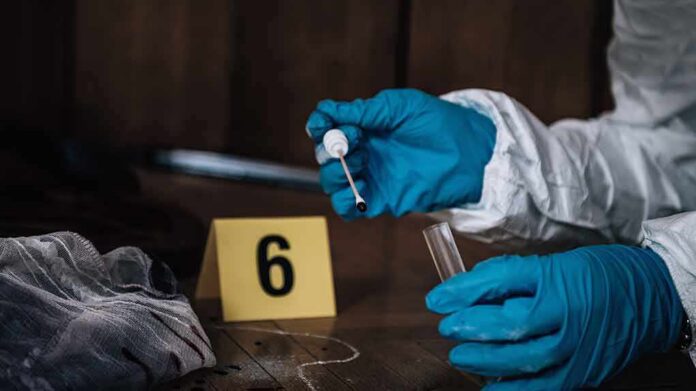
A half-century-old Utah homicide has been closed not by a confession or a witness, but by a genetic through-line: investigators linked biological evidence from Melissa Ann Smith’s 1974 murder to evidence from Laura Aime—and then to Ted Bundy’s archived DNA—using Y-chromosome profiling supported by modern STR testing and a carefully preserved evidence record.
At a Glance
- Utah authorities closed the 1974 homicide of 17-year-old Melissa Ann Smith after DNA connected her case to Bundy.
- The Utah State Crime Lab matched a Y-STR profile from Smith’s evidence to a Y-STR profile from Bundy victim Laura Aime; Aime’s evidence had matched Bundy’s archived DNA.
- Multiple Utah agencies endorsed the conclusion, citing DNA plus pattern, motive, means, and opportunity.
- The case underscores how preserved evidence and Y-STR technology can resolve long-dormant murders—while demanding clear explanation of what lineage evidence proves.
What Investigators Say the DNA Shows
Summit County and partner agencies concluded that Ted Bundy killed Melissa Ann Smith in 1974, based on a DNA chain that starts with preserved forensic material. The Utah State Crime Lab reported a Y-STR profile—male-line genetic markers on the Y chromosome—from Smith’s autopsy evidence that matched the Y-STR profile obtained in the murder of 17-year-old Laura Aime that same fall. Separately, biological evidence in Aime’s case yielded a direct STR DNA match to Bundy’s archived profile, maintained from his Florida casework and incarceration. Taken together, prosecutors argued, the lineage match across the two Utah victims and the direct match to Bundy’s reference profile establish responsibility for Smith’s murder when combined with non-DNA evidence of pattern, motive, means, and opportunity.
Officials didn’t position this as a speculative attribution. The Summit County Sheriff announced the case closure; the Summit County Attorney said explicitly that the DNA and the case facts support the conclusion that Bundy killed Smith. National and local outlets reported the same core account, reflecting a coordinated, on-record law-enforcement finding rather than an off-the-record theory.
How the Forensic Link Works: Y-STRs, Autosomal STRs, and Archival Evidence
Autosomal STRs—short tandem repeats across non-sex chromosomes—power modern individual DNA identifications; match statistics are typically strong because recombination over generations creates highly discriminatory profiles. Y-STRs, by contrast, sit on the nonrecombining portion of the Y chromosome. They tend to pass intact through the paternal line, making them well-suited to isolating the male contributor in mixed samples and to tracing patrilineal relationships—but less suited to singling out a specific man who shares that lineage with male relatives and, sometimes, unrelated men in the broader population.
In this case, authorities describe two complementary results. First, a direct STR match tied Bundy to biological evidence in Aime’s case, the kind of individualizing link that, in modern practice, carries substantial evidential weight. Second, a Y-STR haplotype matched between Aime’s evidence and Smith’s evidence, connecting the two Utah cases through a shared paternal lineage. The lab work relied on samples preserved since the 1970s and processed with updated methods that can recover STR and Y-STR profiles from degraded, trace, or mixture-laden material. That approach is squarely in the mainstream of cold-case practice, where the presence of suitable biological evidence often determines whether a 50-year-old file can be cleared.
Why Authorities Treat the Link as Case-Closing
DNA is not the entire story. Prosecutors and investigators cited the fit with Bundy’s known pattern and movements in Utah in late 1974—his time in the Salt Lake City area, his documented abductions and murders, and his known victimology clustered in young women targeted under similar circumstances. When a high-quality direct STR match ties Bundy to one Utah homicide, and a Y-STR profile ties that homicide to Smith’s, pattern analysis and case chronology do more than decorate the science; they orient the lineage evidence toward the only known individual with a direct match in the chain.
For readers used to CODIS hits and probabilistic genotyping, it helps to think in layers. The Aime evidence supplies the individual anchor: a STR profile that matched Bundy’s known DNA. The Smith evidence provides a lineage bridge to Aime through Y-STRs. Layered together, and tested against Bundy’s known presence, methods, and opportunities in Utah in October–November 1974, investigators concluded the totality meets the threshold to close Smith’s case. Multiple outlets reported that Summit County’s sheriff and attorney’s office jointly announced that closure; no competing account from a named, credible source contradicts this chain.
What Y-STR Evidence Can and Cannot Do
Y-STRs illuminate the paternal line; they do not, by themselves, individuate a single person with the same precision as a robust autosomal STR profile. Men who share a recent paternal ancestor frequently share Y-STR haplotypes, and identical haplotypes can appear among unrelated men due to the population structure of Y lineages. Forensic practice therefore treats Y-STR matches as powerful for exclusion and association—especially to clarify the male contribution in mixtures—while recognizing limits on individual identification unless buttressed by additional evidence or by expanded marker sets that increase haplotype rarity.
In cold-case reality, those constraints are managed rather than wished away. Investigators weigh a lineage link in the context of case facts, geographical and temporal co-occurrence, and any direct DNA anchor available. That is precisely the posture here: the direct STR match to Bundy in Aime provides the anchor; the Y-STR link extends that anchor to Smith; the case record situates Bundy in the right place and time, exhibiting the same criminal pattern. This is why Utah authorities characterize the finding as conclusive for investigative purposes and sufficient to close the file.
52 years later, DNA names her killer.
Ted Bundy.
Melissa Ann Smith, 17, daughter of the Midvale, Utah police chief.
Murdered in 1974.
Bundy was suspected since 1976, finally confirmed by new DNA tech.
Announced 52 years to the day after her body was found.
Bundy murdered… pic.twitter.com/kTMJofyO6H
— Kentucky Girl (@Kentuckygirl1) October 28, 2026
Cold Cases, Evidence Preservation, and the Path to Resolution
The Smith closure is a case study in why agencies invest in preserving biological evidence and revisiting unsolved homicides with new methods. Proper storage, documented custody, and inter-agency collaboration create the conditions under which a fragment of male-line DNA from 1974 can still speak in 2026. The Summit, Salt Lake, and Utah County teams coordinated case files and exhibits across decades; the state lab applied Y-STR and autosomal STR workflows that did not exist when the crimes occurred. That operational discipline—more than any single tool—turns a notorious name into a resolved case rather than an eternal shadow over a victim’s file.
What This Means Going Forward
Two lessons travel well. First, lineage genetics is a force multiplier in historical cases, particularly when autosomal STRs can anchor at least one event in a series; it can connect victims and reconstruct offender movement across jurisdictions when quantity and quality of DNA vary from scene to scene. Second, agencies serve families best when they explain the science plainly: that a Y-STR match tracks a paternal line, that an autosomal STR match can identify an individual, and that the combination—tested against opportunity and pattern—can close the loop with intellectual honesty. Utah’s announcement does both: it names the tools used, credits the preserved evidence that made them useful, and places the DNA where it belongs—inside a larger, coherent case narrative.
Sources:
washingtontimes.com, cnn.com, upi.com, cbsnews.com, adn.com, rmb.reuters.com, parkrecord.com, deseret.com, tandfonline.com, pmc.ncbi.nlm.nih.gov, pubmed.ncbi.nlm.nih.gov
© truthandliberty.com 2026. All rights reserved.