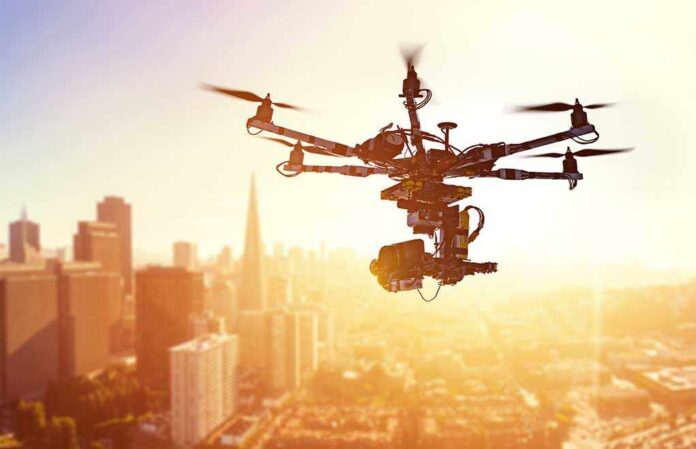
Ukraine’s president says his country’s anti-drone teams are now shooting down Iranian Shahed drones in multiple Middle Eastern states—turning a brutal war lesson into a high-stakes bargaining chip.
Quick Take
- Zelensky says Ukrainian specialists helped intercept and destroy Iranian-made Shahed drones in “several” Middle East countries, described as at least four.
- The deployments reportedly followed U.S. and Israeli strikes on Iran and subsequent Iranian retaliatory drone attacks.
- Ukraine frames the mission as operational combat support—not just training—aimed at building air defenses and trading expertise for interceptors, money, or oil.
- Key details remain unverified publicly, including which countries hosted Ukrainian teams and how many drones were downed.
Zelensky’s claim: Ukrainian teams downed Shaheds outside Europe
President Volodymyr Zelensky told reporters that Ukrainian military experts, including anti-drone personnel, operated in multiple Middle Eastern countries and successfully shot down Iranian-made Shahed drones. He described the activity as more than classroom instruction, saying Ukrainians demonstrated how to work with interceptors and that drones were destroyed in “several” countries. Zelensky’s comments were later released after an embargo, and he indicated the teams remained involved even after a reported ceasefire window.
Those statements matter because they suggest Ukraine is exporting battlefield know-how acquired since Russia’s 2022 invasion, when Moscow used large numbers of Shahed-type drones supplied by Iran. Ukraine’s air defenders have spent years adapting to low-cost, long-range loitering munitions that can overwhelm traditional defenses. By presenting that experience as a deployable capability abroad, Kyiv is signaling it can contribute to allied security beyond Eastern Europe—while still fighting a major war at home.
Why the Middle East, and why now: drone swarms after Iran tensions
The timing described in the reporting ties Ukraine’s deployments to a surge in regional drone activity following U.S. and Israeli strikes on Iran and Iran’s retaliatory drone attacks. In that environment, governments facing Iranian drone threats have immediate incentives to harden air defenses, especially against Shahed-style systems that are relatively cheap and can be launched in numbers. Zelensky’s account positions Ukrainian specialists as practical problem-solvers who can help integrate interceptors, tactics, and procedures under real-world pressure.
Still, the public record is thin on operational specifics. Zelensky did not name the countries involved, and the reports do not provide independent third-party verification—such as on-the-ground footage, after-action reports, or confirmation from host governments—of the intercepts. That limits how confidently outsiders can assess the scale of the claimed downings. What can be said, based on the sourcing, is that multiple outlets attribute the assertion directly to Zelensky and describe it consistently across reports.
Transaction politics: interceptors, funding, and oil in exchange for expertise
Zelensky also linked the deployments to reciprocal benefits for Ukraine, describing a trade of expertise for material support such as air-defense interceptors, financial aid, or oil supplies. For Americans frustrated by endless foreign-policy spending with unclear returns, that framing is significant: it implies Ukraine is trying to offset costs by obtaining tangible resources rather than relying solely on open-ended assistance. Interceptors are especially central because Ukraine’s energy infrastructure remains a repeated target for drone and missile strikes.
The arrangement also fits a broader pattern of states shopping for scalable defense against drones as warfare becomes cheaper and more automated. When relatively inexpensive systems can threaten airports, oil infrastructure, military bases, and population centers, demand rises for layered defenses—radar, electronic warfare, guns, and interceptors. Ukraine’s claim, if accurate, underscores how quickly battlefield innovation can become an export. It also highlights a sobering reality: the same Iranian drone design shows up across multiple theaters, stretching allied defenses worldwide.
What remains unclear—and why it feeds “government failure” concerns
Several key questions remain unanswered by the available reporting: which Middle Eastern states hosted the Ukrainian teams, what legal authorities governed the deployments, how command-and-control was structured, and what concrete compensation Ukraine has already received. In a political climate where many voters—right and left—suspect elites make security decisions behind closed doors, the lack of public detail invites skepticism. It also complicates oversight for democratic governments expected to justify commitments and spending in plain terms.
Ukraine units downed Iran drones in 'several' Mideast states: Zelensky https://t.co/t5UIRUrbOE pic.twitter.com/TsJNYNfHVe
— Hürriyet Daily News (@HDNER) April 10, 2026
For U.S. policymakers under President Trump, the broader takeaway is that Iranian drone technology remains a transnational threat even during diplomatic lulls, and allies are improvising partnerships to counter it. Zelensky’s comments suggest Ukraine wants to be treated not only as a recipient of support but as a security contributor—while still seeking sanctions and energy-related leverage that can collide with other governments’ ceasefire calculations. Until host countries or independent evidence confirms details, the claim should be treated as an informed assertion rather than a fully documented operation.
Sources:
Ukraine units downed Iran drones in ‘several’ Mideast states: Zelensky
Zelensky says Ukrainian experts downed Iranian drones across Middle East
Ukraine shot down Iranian drones in several Middle East states, Zelensky reveals
Ukraine units downed Iran drones in several Mideast states: Zelensky