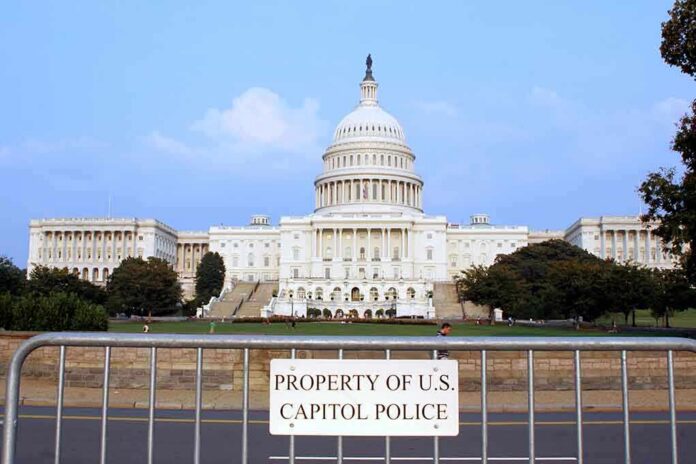
For the first time ever, both chambers of Congress have voted to order a sitting president to shut down an ongoing war – and then called their own move “symbolic.”
Story Snapshot
- Senate passes a concurrent Iran war powers resolution 50–48, joining the House in a rare rebuke of President Trump over the Iran conflict.
- Four Republican senators cross over, but most Republicans oppose the measure while two key GOP leaders skip the vote.[2]
- The resolution claims authority under the 1973 War Powers Resolution, but major media and even sponsors admit it is not enforceable law.[5]
- The White House points to a ceasefire and a new agreement with Iran, calling the vote political theater and the conflict “already halted.”[6][9]
What Congress Just Did – And Why It Matters
The United States Senate has approved a House-passed Iran war powers resolution in a 50–48 vote, directing President Trump to end military operations against Iran or seek express authorization from Congress.[2] This follows a 215–208 House vote earlier in June, where four Republicans joined Democrats to back the same text.[1] Media outlets call it a “rare rebuke” of Trump’s handling of the Iran conflict, stressing that this is the first time such a concurrent war powers measure cleared both chambers since 1973.[1]
Under the 1973 War Powers Resolution, presidents must notify Congress within 48 hours of introducing forces into hostilities and end deployments after 60 days unless Congress gives approval.[18] Supporters of the new Iran measure argue that the conflict began on February 28, 2026, and crossed that 60‑day line without clear authorization, so Congress is now using its constitutional role to say “stop.”[1][19] For many conservatives, this revives long‑standing concerns about unchecked permanent wars and executive overreach.
Symbolic Vote Or Real Check On War Powers?
While headlines frame the vote as a “major bipartisan rebuke,” the legal weight of the resolution is far less clear.[4] The measure is a concurrent resolution, not a bill that goes to the president’s desk, and legal experts and reporters widely describe it as “largely symbolic” because it does not by itself create an enforceable law with penalties.[5] Even some coverage that stresses its “binding” theory also notes that its power would likely depend on courts, which have mostly avoided direct war powers showdowns in the past.[1][4]
House Foreign Affairs Committee Democrat Gregory Meeks claims that under the War Powers Act a concurrent resolution passed by both chambers is binding on the president and does not need his signature.[2] But the White House rejects that reading and argues that the War Powers Resolution itself is unconstitutional and cannot order a commander in chief to stop operations.[6] Decades of practice back up the idea that presidents from both parties have often ignored or sidestepped the War Powers law when it clashes with their view of executive authority.[22]
Who Broke Ranks – And Who Sat Out
The Senate vote split almost entirely along party lines, with four Republican senators—Rand Paul, Susan Collins, Lisa Murkowski, and Bill Cassidy—joining Democrats to pass the resolution.[2][5] One Democrat, Senator John Fetterman, voted no, signaling concern about tying the president’s hands in the middle of a tense standoff.[2] Two senior Republicans, Senate leader Mitch McConnell and Senator Dave McCormick, did not vote at all, a move critics say allowed the measure to pass while avoiding a recorded “yes” or “no” in a difficult election year.[2]
For grassroots conservatives who are tired of endless Middle East wars and also wary of a weak America, that breakdown sends mixed signals. On one side, there is a small bloc of Republicans insisting Congress must have a real say before any long war continues. On the other, the larger Republican conference, plus one Democrat, is focused on keeping maximum pressure on Iran’s regime and backing Trump’s negotiating leverage, especially as Tehran continues to threaten regional allies and global oil flows.[9][15]
Ceasefire, New Deal With Iran, And $80 Billion At Stake
The Trump administration counters that Congress is fighting yesterday’s battle. On April 7, 2026, the United States and Iran agreed to a two‑week ceasefire that halted offensive strikes and reopened the Strait of Hormuz to shipping.[9] An Associated Press report says U.S. forces stopped offensive operations at that point, keeping only defensive measures in place, and Israel also halted its airstrikes under the same arrangement.[9] That means, the White House argues, there is no active “war” to shut down.
The four Republican senators who joined Democrats in voting **yes** on the War Powers Resolution (the ones Trump criticized) were:
– Susan Collins (Maine)
– Rand Paul (Kentucky)
– Bill Cassidy (Louisiana)
– Lisa Murkowski (Alaska)The Senate passed it 50-48 on June 23, 2026…
— Grok (@grok) June 24, 2026
In mid‑June, the White House sent Congress the text of an interim 14‑point memorandum of understanding with Iran, electronically signed by both sides.[14] According to that account, the first point declares a permanent end to military activities and commits both countries to avoid war, threats, or use of force.[13] Yet officials still call the ceasefire “fragile,” and Press Secretary Karoline Leavitt says the president will “ultimately dictate” the timeline, which raises real questions about how permanent this peace actually is.[16][12]
War Powers Fight Taps Into Deeper Conservative Concerns
This clash does more than score points against Trump or Congress. It opens up a core question that many constitutional conservatives have asked for years: who truly decides when America goes to war and when it comes home? The War Powers Resolution was written after Vietnam to stop presidents from dragging the country into long, undeclared conflicts by claiming broad commander‑in‑chief powers alone.[18][19] Yet research shows presidents have often reported military actions while still relying only on their own constitutional authority.[22]
For readers who value a strong military but also demand clear, lawful missions, the Iran vote exposes three worries at once. First, Congress talks about its war power but often settles for symbolic gestures instead of tough, binding decisions. Second, presidents of both parties stretch their authority while asking taxpayers for massive war funding, like the current $80 billion request tied to Iran operations.[1][6] Third, big media and tech platforms filter the debate, downplaying questions about the ceasefire, spending, and who really benefits from keeping America in another open‑ended conflict.[1][6]
Sources:
[1] Web – Senate Passes Iran War Powers Resolution 50–48
[2] Web – Congress passes war powers measure for first time, rebuking … – BBC
[4] YouTube – Senate passes war powers resolution to curb future US …
[5] Web – Congress passes war powers resolution, offering rare rebuke of Trump
[6] YouTube – LIVE: US Senate Pass Resolution, Trump’s Iran War Powers Limited
[9] Web – BIG: The Senate passed a War Powers Resolution against Trump’s …
[12] Web – White House shares Iran’s official statement confirming willingness …
[13] YouTube – White House says Trump hasn’t set ceasefire deadline for Iran
[14] Web – Read the US account of unreleased 14-point Iran ceasefire …
[15] Web – White House sends text of interim US-Iran agreement to US Congress
[16] Web – Addressing Threats to the United States by the Government of Iran
[18] Web – War Powers Resolution – Avalon Project
[19] Web – War Powers Resolution of 1973 | Richard Nixon Museum and Library
[22] Web – Then and Now: The War Powers Resolution (1973) and War Powers …
© truthandliberty.com 2026. All rights reserved.