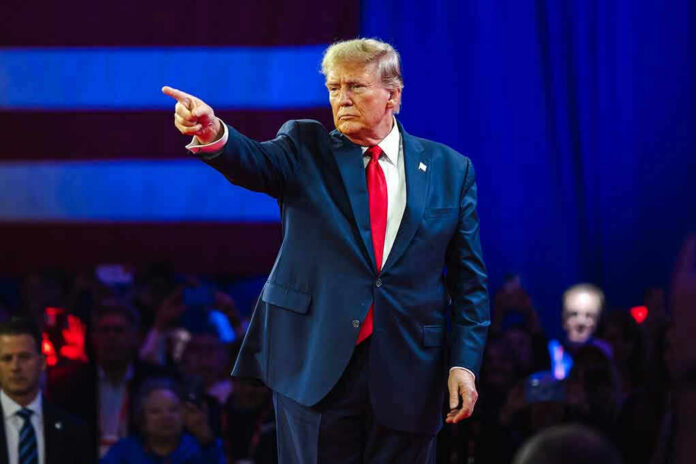
President Trump is daring Congress to prove it can protect the ballot box by refusing to sign any new bills until lawmakers pass the SAVE America Act.
Quick Take
- Trump is tying every major legislative priority to one demand: pass the SAVE America Act with proof of citizenship and voter ID requirements.
- The White House is also signaling added priorities—limits on no-excuse mail voting and anti-trans provisions—that were not part of the earlier House-passed version.
- Supporters call the push a common-sense election integrity measure; critics argue it could block lawful voters who lack specific documents.
- Senate timing remains uncertain as leadership weighs votes alongside looming funding fights, including Homeland Security-related debates.
Trump’s Legislative “Freeze” Strategy Puts Election Rules First
President Trump used his February 25, 2026, State of the Union message and follow-up remarks to lay down a blunt marker: Congress should enact the SAVE America Act before he signs other major legislation. The bill’s core purpose is to require documentary proof of U.S. citizenship when registering to vote, paired with voter ID expectations. Trump framed the move as necessary to stop noncitizen voting and election cheating, claims that remain disputed in available reporting.
Axios reporting also captured Trump’s broader “nationalize elections” rhetoric, including talk of targeting a limited number of jurisdictions if states “fail to count votes honestly.” That language matters because U.S. elections are primarily administered by states under constitutional and statutory frameworks, and federal pressure can quickly become a flashpoint. At the same time, the reporting notes a key limitation: Trump’s description of banning most mail-in voting goes beyond what the SAVE Act itself would fully accomplish.
What the SAVE Act Does—And What Trump Is Trying to Add
The SAVE America Act has been described as a GOP-backed effort focused on documentary proof of citizenship for voter registration, building on years of state-level voter ID fights. Versions of the idea have passed the House before and then stalled in the Senate. This round is different because Trump is linking the measure to an all-or-nothing governing ultimatum. In practical terms, that turns a single elections bill into leverage over budgets, funding bills, and unrelated policy negotiations.
Democracy Docket reported that the White House has confirmed additional demands being attached in the political messaging around the bill, including a push to ban gender transition surgeries for minors and to bar males from women’s sports, plus restrictions on no-excuse mail-in ballots. Those items were described as “common sense” priorities by the White House spokesperson, but the available research also indicates they were not part of the earlier House-passed version. That bundling increases the odds of a Senate showdown and litigation-heavy aftermath.
The Central Dispute: Integrity Measures vs. Access and Administration
Supporters argue that requiring proof of citizenship and voter ID protects election integrity and restores public confidence after years of distrust. Trump has claimed overwhelming support for the concept, including among Democrats, though the research notes that this polling claim is not independently verified in the provided material. Conservative voters who watched loose pandemic-era rules expand mail voting will likely see the demand as a course correction—especially as Washington debates what “secure” elections should look like before the midterms.
Critics, including voting-rights advocacy organizations cited in the research, counter that noncitizen voting is already illegal and described as rare, and they warn the documentary requirements could ensnare eligible Americans who do not have a passport or ready access to a birth certificate. Those concerns often focus on elderly, rural, or low-income voters and on administrative burdens for state and local election offices that would have to verify documents at scale. The research also points to past post-2020 lawsuits being dismissed for lack of evidence of widespread fraud.
Senate Uncertainty, Funding Pressure, and the Midterm Calendar
Senate Majority Leader John Thune has indicated a vote could happen “at some point,” but the reporting suggests timing is complicated by funding fights and other legislative deadlines. The broader context described in the research includes contentious debates over Homeland Security funding and immigration-related pressures. Trump’s tactic effectively raises the cost of delay: if leadership cannot align House and Senate Republicans, the White House position could slow the rest of the agenda and intensify intraparty pressure ahead of 2026 campaigning.
Trump Says He Won't Sign Any New Legislation Until the SAVE Act Is Passed
https://t.co/08CHMNkA29— Townhall Updates (@TownhallUpdates) March 8, 2026
Democrats, led in messaging by Senate Minority Leader Chuck Schumer, have portrayed the legislation as “dead on arrival” and argue it amounts to voter suppression. Outside voices are amplifying both sides, including Elon Musk, who has publicly urged passage in stark terms. What is clear from the available sources is that Trump is trying to force a single national argument: whether proof-of-citizenship voting rules are a basic safeguard or an unnecessary federal escalation. The Senate’s response will determine whether this becomes law or remains a 2026 campaign weapon.
Sources:
https://www.axios.com/2026/02/08/save-america-act-trump-nationalize-elections
https://www.brennancenter.org/our-work/analysis-opinion/trumps-misleading-pitch-save-act
https://www.brennancenter.org/our-work/analysis-opinion/save-act-and-election-power-grab