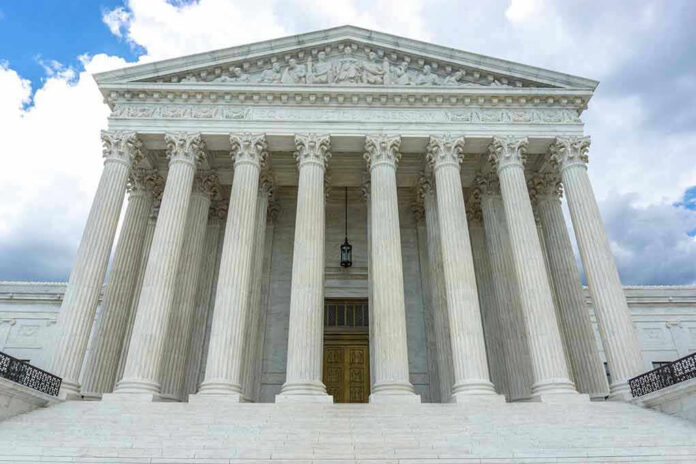
The U.S. Supreme Court’s inaction on election meddling stirs concern for the integrity of future elections.
Story Highlights
- SCOTUS declined a chance to address election meddling, missing a vital opportunity to protect voting integrity.
- Georgia Supreme Court acted decisively against partisan-driven election rule changes.
- Federal courts, including SCOTUS, have not engaged in similar election subversion cases.
- The absence of federal oversight leaves elections vulnerable to manipulation.
Georgia Supreme Court Blocks Partisan Rules
In October 2025, the Georgia Supreme Court permanently blocked controversial election rules proposed by the state’s Trump-aligned Election Board. These rules included allowing local boards to delay certification and mandating hand counts of ballots. This decision highlights the proactive stance of state courts in safeguarding election integrity, contrasting sharply with the absence of federal judicial intervention, particularly from the U.S. Supreme Court.
Federal Courts Remain Silent on Election Issues
Despite the rising threat of election subversion, the U.S. Supreme Court has not taken up major cases addressing these issues since 2020. This reluctance creates a patchwork of state-level judicial responses without a consistent federal standard. The lack of action from SCOTUS leaves state courts as the primary defense against partisan manipulation, raising concerns about the resilience of the nation’s electoral system.
Georgia’s situation is not isolated. Across the country, state courts are frequently called upon to adjudicate disputes over election rules and certification processes. However, without federal oversight, these efforts lack uniformity, potentially undermining the public’s trust in fair elections.
Implications for Future Elections
The absence of federal judicial engagement risks creating uneven standards across states, which could embolden further attempts at election subversion. This scenario threatens voter confidence and increases the likelihood of election disputes. As state courts bear the brunt of these challenges, the call for SCOTUS to step up and provide clear federal guidelines becomes increasingly urgent.
The Supreme Court’s silence risks turning party primaries into playgrounds for political sabotage.
READ MORE: https://t.co/xLmj9Ms3O4
— The American Spectator (@amspectator) October 21, 2025
In conclusion, the U.S. Supreme Court’s inaction on election meddling leaves a significant gap in the defense of national election integrity. While state courts like Georgia’s take decisive action, the need for a cohesive federal approach remains critical to ensure that future elections are free from undue partisan influence.
Sources:
Georgia Supreme Court Ruling Underscores Anti-Democratic Motivations
Trump Administration’s Campaign to Undermine Next Election
Georgia Supreme Court Upholds Block on Hand Counting Rule