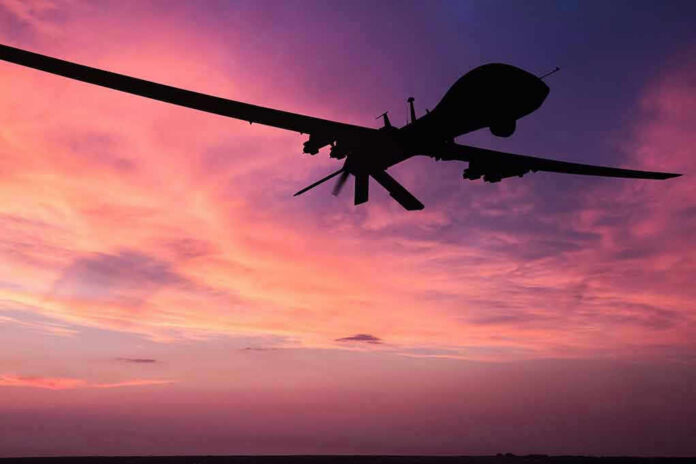
Iran’s latest drone blitz in the Strait of Hormuz shows how fast one regional strike can drag the United States back toward a wider fight.
Quick Take
- Iran said its attack was retaliation after overnight United States strikes and called those strikes a breach of the June memorandum of understanding.[1]
- Bahrain said Iranian drones targeted its territory, while regional officials condemned the attack as a sovereignty violation.[1][8]
- United States officials and conservative media reports said American forces shot down Iranian drones and hit Iranian sites in response.[12][13][17]
- The Strait of Hormuz remains the key pressure point because even short disruptions can rattle shipping and energy markets.[7][19]
Iran Frames the Attack as Retaliation
Iran’s Foreign Ministry said the drone strikes were a direct response to United States airstrikes it called unlawful and a clear breach of the June agreement.[1] A senior Iranian official also described the move as “ceasefire management,” while hardline voices in Tehran urged tougher steps, including pressure on the Strait of Hormuz.[1] That message fits Iran’s long habit of dressing escalation in the language of defense.
That framing matters because Tehran is trying to claim moral cover while the region absorbs the risk. Iran’s side has not produced public forensic proof that every claimed target was a United States asset, and some claims remain unverified in the available record.[1][3] Even so, the official Iranian line is clear: Tehran says it was answering force with force, not breaking a ceasefire.
Bahrain and Regional Governments Push Back
Bahrain said Iranian drones hit the country and condemned the attack as a violation of sovereignty.[1][8] Other regional governments joined the backlash, and Qatar’s foreign ministry also issued a statement condemning renewed Iranian attacks against Bahrain and other neighbors.[11] That united response leaves Iran more isolated diplomatically and gives Washington fresh reason to present the strikes as reckless rather than defensive.
Reports also described damage to civilian infrastructure, including harm to a desalination plant and injuries to civilians.[3][9] Amnesty International said Iranian Shahed drones were most likely used in attacks on civilian infrastructure and said the attacks may amount to war crimes.[9] Those claims are serious, but the available reporting in this package still leaves gaps on exact target identity for each strike.
Trump’s Warning Raises the Stakes
The United States response was fast and blunt. One report said American forces shot down Iranian drones near the Strait of Hormuz and struck Iranian radar sites, while another said Washington carried out strikes after what it called an Iranian drone attack on a commercial ship.[12][13] A broader timeline in the coverage shows the same pattern: attack, retaliation, and then another warning that more force may follow.[1][5][17]
🔴 Breaking: Iran claims it has struck US-linked targets. Bahrain reports an Iranian drone attack and condemns it. A tanker was hit in the Strait of Hormuz.
US and Iran accuse each other of violating the interim ceasefire agreement signed 2 weeks ago. Tensions escalating again!… pic.twitter.com/hEinxefj3E— TheWorldScope (@TheWorldScopeX) June 27, 2026
President Trump has also kept the pressure high with public threats of more strikes, according to the reporting package.[3][5] That matters because Iran now faces a choice between backing down or widening the fight across a chokepoint that carries a huge share of world oil traffic.[7][19] For conservatives who care about American strength, the key question is whether Iran will finally pay a real price for using the region as a pressure valve.
The Strait of Hormuz Remains the Real Flash Point
The Strait of Hormuz is the center of the story because it is not just a battlefield. It is a global choke point. The Council on Foreign Relations says about one-fifth of the world’s oil supply flows through it.[7] That is why every drone launch, every ship hit, and every threat to close the waterway sends shock waves far beyond the Gulf and into fuel prices, trade, and military planning.
This is also why Iran’s claim of “ceasefire management” is so hard to square with reality. The available reporting shows a familiar pattern of escalation, denials, and counterstrikes, not calm control.[1][5][20] Bahrain’s condemnation, United States retaliation, and wider regional alarm all point to a crisis that is still moving, with no clear sign that Tehran is ready to step back.
Sources:
[1] Web – Iran Launches Drone Blitz After Overnight US Strikes, Amid New Trump …
[3] Web – Iran Fired Drones Toward Strait of Hormuz With U.S. Shooting Down …
[5] YouTube – US, Iran Trade Missile and Drone Blows as Kuwait …
[7] Web – Iran has launched a drone assault targeting Bahrain and a ship in …
[8] Web – Iran launched a drone assault targeting Bahrain, while a ship in the …
[9] Web – Bahrain accuses Iran of launching a drone attack targeting … – …
[11] Web – 2026 Iranian strikes on Bahrain – Wikipedia
[12] Web – The Ministry of Foreign Affairs issued a statement on 11 June 2026 …
[13] Web – The Media briefing by the National Communication Centre on the …
[17] YouTube – BREAKING: US shoots down Iranian attack drones in Strait of Hormuz
[19] Web – The U.S. military carried out strikes against targets in Iran on …
[20] Web – 2026 Iran war – Wikipedia
© truthandliberty.com 2026. All rights reserved.