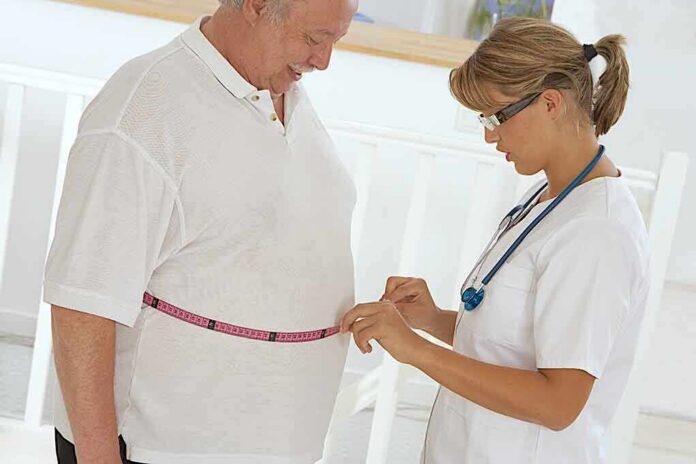
The most dangerous thing about BMI isn’t that it’s “wrong,” it’s that it can make the wrong people feel safe and the right people panic.
Quick Take
- A major 15-year U.S. study found BMI did not predict mortality, while direct body-fat measurement did.
- BMI can mislabel muscular people as “obese” and miss high-risk people with normal weight but excess abdominal fat.
- New obesity definitions add waist-based measures and would classify roughly two-thirds to three-quarters of U.S. adults as obese.
- Bioelectrical impedance analysis (BIA) is emerging as a practical clinic-friendly alternative to BMI for body-fat estimation.
The 2025 study that punctured BMI’s authority
Researchers at UF Health tracked 4,252 U.S. adults for 15 years and asked a blunt question: does BMI actually predict who dies? Their answer landed like a cold splash of water—BMI showed no statistically significant association with all-cause mortality or heart-disease mortality. The same dataset told a different story when the researchers looked at measured body fat using bioelectrical impedance: high body fat tracked with sharply higher risk.
That gap matters because BMI has been treated like a “vital sign” in everyday medicine, insurance forms, workplace screenings, and even casual self-judgment. When a number gets that much cultural power, people stop asking what it measures. BMI measures mass relative to height. It does not measure body fat, fat location, fitness, muscle, or the metabolic stress that often drives diabetes and heart disease. The UF result forces the uncomfortable question: what problem was BMI solving?
What BMI measures well, and what it routinely misses
BMI began in the 1830s as a statistical description of the “average man,” then insurance and public-health systems adopted it because it is cheap, fast, and standardized. For population surveillance, that simplicity still has value. For an individual, the blind spots are obvious to anyone who has met a lean, strong 55-year-old who lifts weights or a thin-looking 62-year-old with a widening waistline and worsening blood sugar.
Muscle is dense; visceral fat is sneaky. BMI can overpathologize the former and under-detect the latter. That mismatch shows up in real life: a person can “improve” BMI by losing muscle with age, injury, or inactivity, while metabolic risk climbs. Another person can carry more weight but store less in harmful abdominal depots and show better cardiometabolic markers. Common sense says body composition and fat distribution should matter more than a single ratio, and the newer research is catching up.
Why waist-based definitions are exploding the official obesity count
Late 2025 and early 2026 brought a different kind of shock: not about whether BMI predicts death, but about how many Americans would be labeled obese if clinicians took fat distribution seriously. A major analysis applying newer criteria that add waist circumference and related ratios found obesity prevalence jumping from roughly 43% (BMI-only) to about 69%. Separate reporting framed it even more starkly: under some approaches, three in four U.S. adults qualify.
The detail that should grab any reader over 40: older adults get reclassified in huge numbers. Some analyses suggest around 80% of people over 70 land in an “obese” bucket under the new criteria. That doesn’t automatically mean 80% need a prescription tomorrow. It means waist-centered measures catch what BMI downplays in later decades—less muscle, more central fat, and the rising odds of diabetes, heart disease, and mobility decline. The label may be clumsy, but the risk signal is real.
BIA: the “good enough” tool that could replace BMI in clinics
DEXA scans can map fat and lean tissue precisely, but most primary-care clinics can’t run everyone through imaging. BIA steps into that gap. It estimates body fat by sending a tiny electrical current through the body and measuring resistance. It is not perfect, but it is far closer to the question people actually care about: how much fat do I carry, and how is my health likely to play out? In the UF analysis, BIA-based body fat meaningfully predicted mortality where BMI didn’t.
That practicality is the real story. When research points to a better metric but it’s too expensive or complicated, nothing changes. BIA is cheap enough and simple enough to move from research papers into everyday checkups. People should treat BIA like blood pressure cuffs: not a moral scorecard, not a final verdict, but a useful signal that improves with repeat measurements and context. If your clinic offers it, ask for the number and ask what it means alongside labs, fitness, and waist size.
How much should you personally worry about your BMI?
Worry is the wrong tool; triage is the right one. BMI can still serve as a quick screening flag, especially at extremes, but it should not be the end of the conversation. A “normal” BMI should not reassure someone with a growing waistline, high triglycerides, rising A1C, sleep apnea, or a family history of early heart disease. An “obese” BMI should not automatically condemn a strong, active person with good blood pressure, strong labs, and a modest waist measurement.
American common sense and conservative values both push toward practical, measurable accountability: focus on what predicts outcomes and what you can change. Waist size, strength, aerobic capacity, blood pressure, fasting glucose/A1C, lipids, and sleep quality respond to daily habits more reliably than chasing a BMI target. If new definitions expand the obesity label to include more people, the right response isn’t panic or pharma-first thinking. The right response is better measurement, honest risk discussion, and lifestyle changes that don’t require a bureaucratic rebrand.
The open loop in all this: broader definitions could help identify “hidden risk” earlier, but they could also medicalize millions of people who mainly need better food, more movement, and less sitting. If the health system uses better tools like BIA and waist metrics to guide targeted, individualized action, the shift will be a win. If it becomes a numbers game that feeds stigma and one-size-fits-all treatment, BMI will get replaced by something just as blunt.
Sources:
https://ufhealth.org/news/2025/uf-health-study-shows-bmis-weakness-as-a-predictor-of-future-health
https://www.sciencedaily.com/releases/2025/12/251227004140.htm
https://advances.massgeneral.org/endocrinology/article.aspx?id=1613
https://sanantonioreport.org/under-new-criteria-3-in-4-u-s-adults-considered-obese-san-antonio/
https://www.who.int/news-room/fact-sheets/detail/obesity-and-overweight
https://abcnews.com/US/obesity-rise-19-million-affect-126-million-american/story?id=129652323
https://data.worldobesity.org/publications/WOF-Obesity-Atlas-2026-2026-03-02.pdf