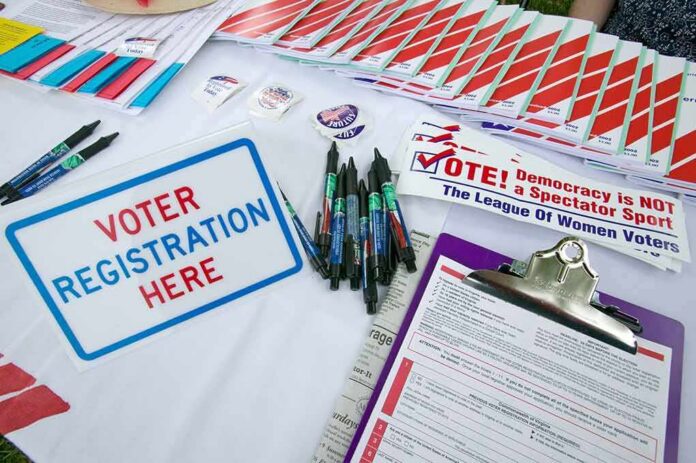
A 20-year scheme paying homeless people to register to vote on Los Angeles’ Skid Row has exploded into a national fight over who is really guarding America’s elections — local officials or federal investigators and powerful tech vendors.
Story Snapshot
- A California petition worker has agreed to plead guilty to a federal felony for paying homeless people to register to vote on Skid Row.
- Federal prosecutors say she ran the scheme for about 20 years, using cash payments of just a few dollars to entice registrations.
- The case is now a key example in a broader clash between the Trump administration and California over alleged non-citizen voting and dirty voter rolls.
- Election software companies and federal officials are pointing at local election offices, arguing that weak checks allowed bad registrations to slip through.
Federal case exposes cash-for-votes scheme on Skid Row
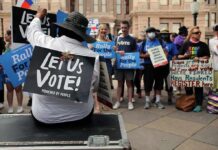
Federal prosecutors say Brenda Lee Brown Armstrong, a 64-year-old Marina del Rey resident and longtime petition circulator, spent years paying people, including homeless residents of Skid Row, to register to vote. According to the United States Department of Justice, she has been charged with one felony count of paying another person to register to vote and has agreed to plead guilty. Officials say she offered cash, usually between two and three dollars, to induce people to sign voter registration forms and petitions. The case highlights how vulnerable people living on the streets can be pulled into election schemes for pocket change, with little real say over the system that claims to represent them.
Justice Department documents describe Armstrong’s work as part of a long-running effort tied to ballot initiative campaigns, where petition circulators are often paid per signature. Investigators say she sometimes supplied fake or borrowed addresses, including letting people use her own, creating voter records that did not match real living situations. Federal officials stress that she knowingly paid at least one person to register to vote in federal elections, which made the case a clear federal crime. The Federal Bureau of Investigation and prosecutors in the Central District of California handled the investigation, not California state or local election authorities. For many voters, that fuels the feeling that local officials either did not notice or did not act until Washington stepped in.
California’s pattern: real fraud cases, but low overall numbers
California’s own research shows that documented election fraud cases remain small compared with the tens of millions of votes cast in the state. Reviews of voter fraud in California over recent years find that most prosecutions involve registration and petition schemes, often targeting homeless communities or unsuspecting residents, instead of large numbers of regular voters casting fake ballots. Past cases include charges against twelve people in Orange County for unlawfully registering people to vote and bribing homeless individuals with cigarettes and money for fake signatures. These scattered prosecutions support two truths at once: some actors are clearly gaming the system, yet the proven number of fraudulent registrations and votes is tiny next to the size of California’s electorate. That tension feeds public anger on both sides — some see a suppressed crisis, others see political fear-mongering.
Experts who study election integrity say that while fraud exists, they have found no evidence of widespread, organized voter fraud in California. Independent reviews and media fact-checks note that most recent investigations have focused on registration problems, petition scams, and isolated ballot abuses, not on mass non-citizen voting or large-scale stolen elections. One review of valid voter fraud complaints in California counted only dozens of cases, far from the millions sometimes claimed in political speeches. These findings clash sharply with claims pushed by national figures who argue that the state’s entire system is riddled with illegal voting. For many Americans, this gap between expert data and political rhetoric deepens mistrust of both government and the media, and raises suspicions that powerful people are hiding something — or weaponizing fear.
Non-citizen voter roll fight pulls in software vendors and “deep state” fears
The Armstrong case broke at the same time the Trump administration escalated a broader clash with California over alleged non-citizen voter registrations. The Department of Homeland Security claimed that more than 190,000 non-citizens were registered to vote in California and over 250,000 across four states, but offered no public evidence that those people had actually voted or that the numbers were solid. California officials, including Democrats in state leadership, have strongly rejected those claims, calling them speculative and unsupported. Meanwhile, a Trump-appointed federal prosecutor says his office is pursuing multiple election fraud investigations in California and has pointed to the Armstrong case as proof that “we do have evidence to the contrary” of the “no fraud” narrative. This back-and-forth leaves ordinary voters stuck between dueling elites, each insisting they alone defend democracy.
🚨 The DOJ secured a federal guilty plea in a California voter fraud case — but James O'Keefe says no state official has made a single arrest or launched a prosecution.
O'Keefe Media Group's undercover journalists posed as homeless individuals on Skid Row in Los Angeles in March… pic.twitter.com/v0xcZnEvDF
— Lincoln Media Foundation (@LincolnMediaHQ) July 21, 2026
Election software companies are also being pulled into the fight, as federal officials and political commentators ask why databases did not catch bad registrations tied to fake or borrowed addresses. Some vendor-aligned voices argue that their systems only process what local election offices send them, and that counties and the state bear responsibility for cleaning up their voter rolls. California’s secretary of state points to existing laws that bar election officials from tampering with ballots or voter data and stresses that official systems have many checks against fraud. Yet for Americans watching from both left and right, the picture looks familiar: federal agencies, state officials, and private tech firms pointing fingers at each other, while admitted fraud cases like Armstrong’s show that determined actors can still slip through the cracks. That fuels a growing belief that the system mainly protects itself, not the people it is supposed to serve.
Sources:
redstate.com, youtube.com, facebook.com, pbs.org, cnn.com, sos.ca.gov, selc.senate.ca.gov, archive.amarkfoundation.org, calmatters.org, reddit.com
© truthandliberty.com 2026. All rights reserved.