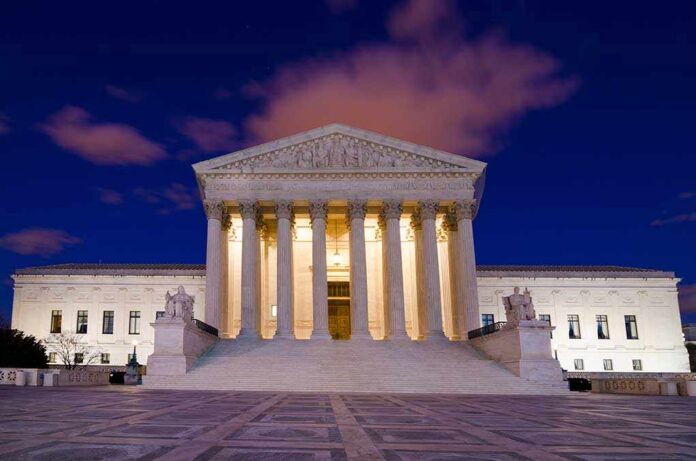
A single executive order is now forcing the Supreme Court to decide whether any president can redefine American citizenship without Congress—or even a constitutional amendment.
Story Snapshot
- The Supreme Court heard oral arguments April 1, 2026 in Barbara v. Donald J. Trump, a direct challenge to President Trump’s 2025 birthright-citizenship executive order.
- The order targets babies born after Feb. 19, 2025 to parents lacking permanent legal status, placing thousands of newborns in legal uncertainty.
- Lower courts have blocked the order at every step so far, including a federal appeals court that upheld an injunction in October 2025.
- The legal fight centers on the 14th Amendment’s Citizenship Clause and whether the executive branch can narrow it through administrative action.
What the Supreme Court is being asked to decide
The Supreme Court’s April 1 hearing put a blunt constitutional question on the table: can the president, by executive order, restrict who is recognized as a citizen at birth under the 14th Amendment. The case challenges an order President Trump signed on Jan. 20, 2025, aimed at children born in the U.S. after Feb. 19, 2025 to parents without permanent legal status. The order has been blocked in lower courts.
The plaintiffs, led by the ACLU and partner organizations, argue the Citizenship Clause has been applied for roughly 125 years to grant citizenship to children born on U.S. soil, and that the order cuts against that long-standing reading. The administration argues the clause was meant to secure citizenship for former slaves and their children, not for children of undocumented immigrants. The Court’s ruling will determine whether the injunctions remain.
A timeline that matters: injunctions, appeals, and a class-wide case
Courts moved quickly after the order was signed. Legal groups challenged it within hours, and by February 2025 a federal judge temporarily blocked it. The government appealed, and arguments were heard in August 2025. On Oct. 3, 2025, a federal appeals court upheld the block, continuing a pattern the challengers highlight: judges have repeatedly rejected the administration’s constitutional theory. The case also involves a certified class covering all babies subject to the order.
That class-wide posture raises practical stakes for families and for federal agencies. If the government were allowed to implement the order while litigation continued, parents could face delays or denials when seeking documents that typically follow automatically from birth in the United States. The ACLU says families have reported fear and confusion about how hospitals, state vital-records offices, and federal benefit systems would treat newborns if citizenship were suddenly disputed at the administrative level.
Constitutional guardrails conservatives should care about
Conservative voters are rightly skeptical of activist government, whether it comes packaged as progressive social engineering or as executive-branch shortcuts that bypass the Constitution. This case puts that tension front and center. Even Americans who want tighter immigration enforcement still have to ask: if a president can “re-interpret” a constitutional guarantee by executive order, what stops a future administration from re-interpreting other rights the same way. The Court’s answer will shape those limits.
The challengers’ argument focuses on text and precedent: the 14th Amendment’s language and the Supreme Court’s long-running application of birthright citizenship. They also argue Congress—not the White House—sets the rules that implement citizenship and immigration policy within constitutional bounds. The administration’s counterargument seeks a narrower reading of “subject to the jurisdiction,” and it has asked the Supreme Court to deliver a different outcome than the lower courts have provided to date.
What happens next, and what to watch for after the arguments
President Trump attended the April 1 arguments, signaling the political weight the White House attaches to the dispute and the broader immigration debate. The Court has not issued a decision yet, and the scope of any ruling will matter as much as the result. A narrow decision could focus on procedural issues or the order’s specific mechanics. A broad decision could reshape national birthright citizenship practice and redefine how far executive power reaches.
For voters who feel burned by decades of elite “rules for thee” governance, the key question is whether the administration can achieve an immigration-policy goal through a method that courts view as constitutionally improper. The record so far shows lower courts have blocked the order unanimously, but the Supreme Court is the final word. If the Court tightens or expands executive latitude here, that precedent will echo far beyond immigration into the separation-of-powers fights ahead.
Sources:
https://www.aclu.org/cases/barbara-v-donald-j-trump