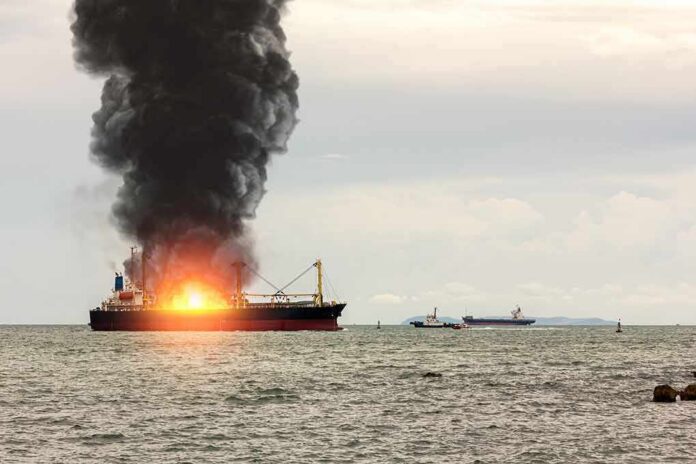
An Indian cargo ship just sank in the Red Sea after an attack near Yemen, and it is another warning that global shipping lanes — and the ordinary workers who keep trade moving — are wide open to war and politics.
Story Snapshot
- An Indian-flagged vessel sank in the Red Sea off Yemen after an attack, but all crew survived.
- India’s government condemned the strike as an “unprovoked” attack on a defenseless civilian ship.
- Yemeni forces say they rescued 14 sailors, while India stresses that 13 of them were its citizens.
- Conflicting reports on the weapon and blame show how fast-moving conflicts can hide clear facts.
Attack on a civilian cargo ship in a growing war zone
India’s Ministry of External Affairs said an Indian-flagged commercial vessel, MSV Faize Noore Oliya, sank in the Red Sea off the coast of Yemen after being hit during an attack on August 4, 2026. The ministry called it an “unprovoked” strike on a defenseless civilian ship, stressing that this was not a war vessel but a trading boat carrying workers going about their jobs. The Indian government publicly thanked Yemeni authorities for helping the crew and made clear it views the attack as part of a wider threat to safe passage at sea.
Reports from Yemeni government forces say the ship was attacked about 13 nautical miles south of Hodeidah, a port city on Yemen’s western coast. That area sits right on one of the world’s key shipping routes, where cargo ships move goods between Europe, Asia, and the Middle East. Yemeni National Resistance Forces said coast guard and naval units carried out a joint rescue after the vessel was struck by what they described as an explosives-laden boat. This claim fits a larger pattern of sea drone and bomb-boat attacks that have put nearby waters on high alert.
All crew rescued, but basic details still do not line up
India’s statement says all 13 Indian nationals on board were safely rescued. Yemeni authorities go a step further and say 14 people were on the ship, including 13 Indian sailors and one Yemeni sailor, and that all of them were saved and taken to safety for medical checks. The two counts likely differ only because India focused on its own citizens, but the mix-up shows how even simple facts, like head counts, can get fuzzy when officials rush to respond and the media races to report.
There is also confusion about how the ship was hit. India’s shipping minister Sarbananda Sonowal, speaking through Indian media, said the vessel was struck by a projectile near Yemeni waters, which caused it to capsize and sink. Yemeni National Resistance Forces, on the other hand, described the strike as coming from an explosives-laden boat. Other outlets mention a “missile strike” or “projectile” without more detail. No full forensic report or damage study has been made public, so it is still not clear whether the weapon was a missile, a drone, or a bomb boat.
Blame, geopolitics, and a fragile global trade system
The Yemeni National Resistance Forces blamed Yemen’s Houthi movement for the attack, fitting it into a wider story of Houthi strikes on ships in the Red Sea. At the same time, reports note that the Houthi side has not yet publicly claimed responsibility for this specific sinking. This matters because, in conflict zones, early blame can harden into “truth” before investigators can fully check what really happened. Governments and armed groups all try to shape the story, and regular people are left to sort out which claims they can trust.
Just in: Indian Shipping minister Sarbananda Sonowal statement on sinking of Indian commercial vessel in Red Sea
"Indian MSV Faize Noore Oliya has been hit by a projectile near Yemeni waters, causing the vessel to capsize and sink. India strongly condemns this unprovoked attack…
— Sidhant Sibal (@sidhant) August 4, 2026
For many Americans, this incident feels like one more example of how global elites and warring factions play games over trade and power while workers carry the risk. A small cargo vessel, crewed by 13 Indians and one Yemeni, became a target in a fight that had nothing to do with them personally. They were lucky to survive, but the next crew might not be. Similar Red Sea attacks have already killed sailors from countries like the Philippines and Russia, showing how deadly these strikes can be when rescue fails or comes too late.
India’s reaction also exposes a deeper problem that resonates in the United States. The ministry warned that attacks on commercial ships and civilian mariners keep rising and said freedom of navigation and trade must not be obstructed. That sounds good on paper, but in practice global powers have allowed key waterways to turn into shooting galleries. Insurance costs climb, shipping prices go up, and regular people pay more for goods while watching world leaders offer strong words but weak protection. Many Americans, conservative and liberal alike, see the same pattern at home: big talk, little action, and ordinary workers left in harm’s way.
Why this matters far beyond the Red Sea
Attacks like this Indian ship sinking highlight how fragile today’s world economy really is. A single small vessel can be hit and sunk near Yemen, and the shock waves reach ports in India, Europe, and even the United States through higher prices and longer delays. Every time a ship is struck, more companies reroute or slow traffic, which adds fuel costs and pushes up inflation that families already struggle to afford. Voters across nations look at events like this and see more proof that global systems serve the powerful first and protect working people last.
This case also shows how quickly narratives can outrun hard facts. Within hours, media and officials framed the attack as part of a larger Houthi campaign, even though the exact weapon and direct proof of responsibility remain unclear. That does not mean the claim is false, but it does mean citizens should stay alert when complex events are squeezed into simple talking points. In a time when many believe a “deep state” of elites manages information to suit its goals, demanding clear evidence before accepting neat stories is not cynical; it is common sense.
Sources:
insiderpaper.com, siasat.com, x.com, newsx.com, youtube.com, themedialine.org, timesofisrael.com, moneycontrol.com
© truthandliberty.com 2026. All rights reserved.