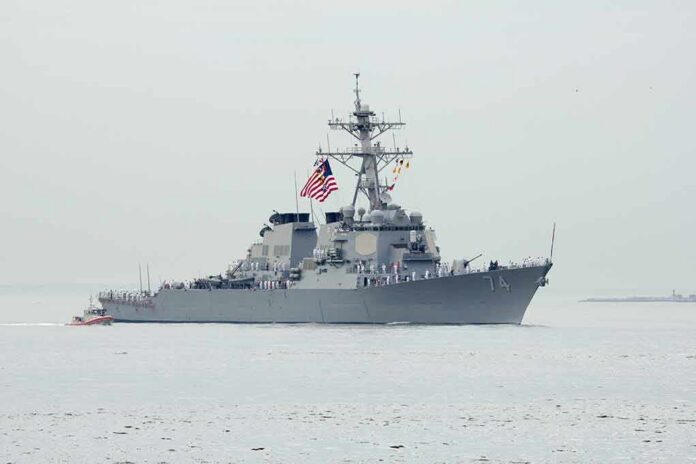
After Iran-backed Houthis struck oil tankers, the United States vowed “major punishment” and is now hitting both the terrorists and their sponsors where it hurts most — their ability to threaten global shipping and American lives.
Story Snapshot
- U.S. forces are striking Iran and Iran-backed Houthis after attacks on commercial tankers and shipping.
- Central Command says the goal is to stop attacks on civilian mariners and keep key sea lanes open.
- Iran denies directing the tanker strikes, but has not offered proof clearing its role with the Houthis.
- Trump’s team faces the challenge of hitting back hard while avoiding endless, open-ended war in the region.
What Triggered the New U.S. Strikes
U.S. Central Command says recent American strikes are a direct answer to Iranian attacks on commercial ships and civilian mariners in and around the Strait of Hormuz, one of the world’s most important energy lanes. In one case, the military pointed to an attack on the Singapore-flagged cargo ship M/V Ever Lovely, saying U.S. forces hit Iranian targets the next day as a “powerful response” to the strike. Major outlets report a similar pattern: tanker hit, then U.S. retaliation against Iranian military sites.
Trump had already ordered a cycle of “self-defense strikes” on Iran earlier in the summer, after the Pentagon tied Iranian installations to attacks on U.S. troops and commercial vessels. Central Command says these operations are meant to be measured, not random, and focused on forces that threaten ships and sailors. At the same time, the White House has warned that if Iran and its proxies keep targeting tankers, the United States is ready to expand combat operations, including more intense strikes inside Iran itself.
How Houthis, Iran, and Tanker Attacks Fit Together
This latest showdown does not come out of nowhere. Since the 2023–2024 Red Sea crisis, Iran-backed Houthi militants in Yemen have attacked commercial ships with missiles and drones, claiming to target vessels linked to the West and Israel. The United States and the United Kingdom answered with repeated airstrikes on Houthi launch sites, radar systems, and missile storage, saying they wanted to protect “freedom of navigation” for global trade. U.S. officials stress that the Houthis depend on Iranian support, training, and weapons pipelines.
Central Command and the Pentagon describe a clear pattern: Houthis hit tankers and cargo ships in the Red Sea and nearby waters, then U.S. and partner forces strike Houthi military assets and, increasingly, Iranian capabilities that enable those attacks. In 2025, hundreds of U.S. strikes under what became known as Operation Rough Rider hit Houthi targets and were said to sharply reduce their ability to fire on shipping, though not to end the threat completely. Now, as Houthi attacks spread and a Saudi-owned tanker is hit again, Trump is signaling that Tehran, not just its proxies, will pay a heavy price.
Inside the Current U.S. Target List
Recent U.S. operations against Iran have gone far beyond a few missile batteries. Central Command reports strikes on maritime capabilities, missile and drone storage sites, coastal surveillance systems, and air defense assets that guard Iran’s coastline. Other reporting describes attacks on bridges, power stations, and logistics hubs inside Iran, signaling a push to disrupt how Iran moves and supplies forces that threaten global shipping. In the Strait area, the U.S. military says it has even redirected or disabled commercial vessels to stop them from entering or leaving Iranian ports tied to the conflict.
The fight has also hit the Houthis’ money flow. U.S. strikes recently destroyed an oil terminal at Ras Isa in Yemen, which American officials called a key financial lifeline for Houthi terrorists. Houthi authorities claimed dozens of civilians were killed there and labeled the strike a “war crime,” while Iran’s foreign ministry blasted the operation as “barbaric.” U.S. Central Command, by contrast, said the goal was to choke off funds used to buy weapons and launch more attacks on tankers and international trade routes in the Red Sea.
Where the Evidence Is Strong — and Where It Is Thin
For conservatives who remember past Middle East wars, the big question is proof. On one hand, the public record is clear that Iran-backed Houthis have hit commercial shipping again and again, and that Iranian Revolutionary Guard networks support them with training, missiles, and intelligence. It is also clear that Iran’s own forces have attacked or harassed ships in the Strait of Hormuz, including the M/V Ever Lovely and at least three other commercial vessels in recent months. Those attacks on global energy and trade are facts, not rumors.
Secretary of State Marco Rubio said Thursday that Iran is privately “begging” the U.S. for a deal to end the war, but argued that Tehran is not yet serious about reaching an agreement.
“Iran is begging us, both directly and indirectly, ‘Let’s do a deal. Let’s talk,’” Rubio said… pic.twitter.com/ETv0Jl2ll6
— Mosheh Oinounou (@Mosheh) July 23, 2026
But the declassified record still has gaps. The United States has not released intercepted orders, drone footage, or other direct proof showing Tehran commanding the specific tanker strikes now cited as the trigger for the latest U.S. blows. News outlets mostly quote what the Pentagon “said” about Iranian aggression, not a court-tested finding. Iran, for its part, loudly denies the charges and complains about violated ceasefires, but offers no hard evidence that some other actor carried out the attacks. That leaves ordinary Americans caught between U.S. statements and Iranian denials, with much of the core intelligence still locked behind classified doors.
What It Means for American Strength and Security
For Trump supporters, one thing is clear: doing nothing is not an option when radical groups backed by Iran fire missiles at tankers, drive up oil prices, and endanger American sailors and truckers back home. When energy routes choke, working families pay more to fill up their cars and heat their homes — another hit after years of inflation and globalist mismanagement. By going after Iranian command centers, coastal radar, and Houthi launch sites, the administration is trying to restore deterrence and put teeth behind the promise that America will protect free commerce.
At the same time, conservatives value the Constitution and do not want another endless, undeclared war. So far, reporting shows these strikes have been ordered by the executive branch as acts of self-defense, not under a fresh, specific authorization from Congress. That creates a tension many patriots feel: strong action is needed, but clear limits and accountability matter too. The next key step will be whether the administration declassifies more proof tying Tehran to the tanker attacks and sets out a clear end state — crushing the terror threat to shipping without sliding into a permanent occupation or blank-check conflict in Iran.
Sources:
en.wikipedia.org, centcom.mil, cfr.org, npr.org, nytimes.com, usatoday.com, reuters.com, bbc.co.uk, youtube.com, war.gov, abcnews.com, cbsnews.com, aljazeera.com
© truthandliberty.com 2026. All rights reserved.