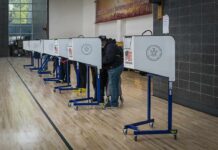
Congress just approved a “show your papers” voting mandate that could reshape how Americans register and vote nationwide—right as the 2026 election cycle is already underway.
Story Snapshot
- The House passed the SAVE America Act on February 11, 2026, sending a sweeping election rules package to a Senate that has not yet voted.
- The bill would require documentary proof of U.S. citizenship for voter registration and tighten photo ID requirements for federal elections.
- Supporters frame it as an election-integrity measure; opponents argue it would block or delay lawful voters who lack ready documentation.
- Multiple analyses warn immediate implementation could disrupt primaries and mid-cycle administration, especially in mail-heavy states.
- Claims that noncitizen voting is widespread remain unverified in the provided research, a key weakness in the argument for a federal overhaul.
House Passage Sets Up Senate Clash Over Federal Control
The House approved the SAVE America Act on February 11, 2026, after earlier versions advanced in 2024 and April 2025 but failed to clear the Senate. The 2026 bill is widely described as a rebranded and expanded successor to the prior SAVE Act, with new mandates that would override many state processes. Senate leaders have not scheduled a final vote, and discussions about bypassing the filibuster have intensified as primaries begin.
The practical reality is timing: several states are already in early voting windows or have mailed ballots for primaries. Critics argue that rewriting registration and identification rules midstream invites administrative breakdowns, litigation, and voter confusion. For conservatives who want clean elections, a system that is unworkable in practice can backfire—because chaos undermines confidence just as surely as misconduct does.
What the Bill Requires: Citizenship Proof, Photo ID, and Mail-Voting Changes
The legislation would require documentary proof of citizenship for voter registration, not merely an attestation under penalty of perjury, and it would impose strict photo ID standards for federal elections. Analyses cited in the research also describe requirements affecting mail voting, including providing copies of identification with ballots. The proposal goes beyond typical state voter-ID laws by setting a nationwide federal baseline that states would need to implement quickly.
Supporters argue the bill closes loopholes and standardizes enforcement, pointing to razor-thin elections as proof that every invalid vote matters. Opponents counter that existing federal law already restricts voting in federal elections to U.S. citizens, with states using affidavits, list maintenance, and other checks. That dispute matters because a major federal expansion is hardest to justify when the underlying problem is asserted broadly but not demonstrated with clear evidence.
Implementation Risks: Disenfranchisement Warnings and Administrative Strain
Opposition groups estimate that tens of millions of Americans may lack immediate access to documents like passports, and they argue the burden would fall unevenly on married women, low-income voters, Native Americans, and people who do not keep birth certificates readily available. The research also highlights the experience of Kansas’ 2011 proof-of-citizenship law, which blocked tens of thousands of voter registrations before the policy was curtailed.
The bill’s mid-2026 timing is a recurring red flag among critics because election offices operate on fixed calendars, vendor contracts, and state statutory deadlines. All-mail and high-mail states would face additional logistical hurdles if voters must include ID copies or meet new verification steps. Even voters who ultimately qualify can be deterred by paperwork friction, long lines, or unclear instructions—problems that land on local election workers, not Washington lawmakers.
Evidence Gap and the Constitutional-Trust Question
The research notes that claims of widespread noncitizen voting have been repeatedly contested, including references to a prior federal commission that did not produce evidence supporting the scale of the allegations. That doesn’t mean safeguards are unnecessary; it means lawmakers have to weigh costs, benefits, and the risk of restricting lawful votes. Conservatives generally favor limited government, so a federal takeover of state election mechanics demands a high proof threshold and careful rollout.
The SAVE America Act Is the Most Popular Election Reform in Decades – Joe Hoft @SenateGOP @SenateDems THE PEOPLE WHO PAY YOU WANT THIS REFORM, PASS IT https://t.co/INkBz4dnr3
— Dr. Sharon Richert (@srichert49) March 13, 2026
Senate dynamics now determine whether the SAVE America Act becomes law, is amended, or stalls again. Sponsors and allies are pushing urgency, while some Senate voices are described in the research as skeptical of overriding state control. If the bill advances, the central policy test will be whether it strengthens election integrity without creating a bureaucratic gauntlet that punishes eligible citizens—because the Constitution’s promise is not just secure elections, but fair access for lawful voters.
Sources:
How the SAVE Act Threatens Freedom to Vote
9 Things to Know About the Proposed SAVE America Act
The SAVE Act and an Election Power Grab
SAVE Act Headed to Senate in Push to Restrict Voting Access