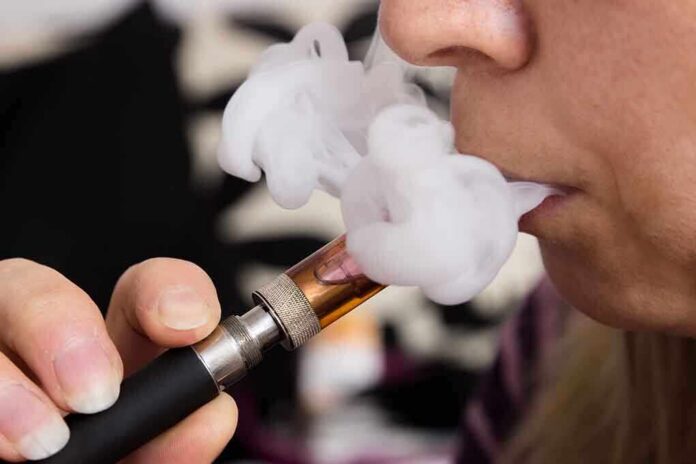
Smokers and vapers face a coordinated assault on their wallets through state tax hikes and federal tariffs that could reshape consumption habits in ways public health officials never anticipated.
Quick Take
- New Jersey, Washington, and Michigan are implementing dramatic tax increases on cigarettes and vaping products, with some taxes tripling or nearly doubling prices overnight.
- A 25 percent federal tariff on imported vapes from China is driving retail prices up 10-15 percent as inventory depletes, forcing manufacturers to shift production domestically.
- Policymakers aim to generate hundreds of millions in state revenue while discouraging youth nicotine use, but critics warn the regressive taxes disproportionately harm low-income smokers and may backfire.
- The price increases create an unintended consequence: adult smokers considering switching to vaping may find the cost gap narrowing, potentially reversing harm-reduction progress.
The Perfect Storm: Taxes Converge on Nicotine Users
The timing could not be worse for nicotine consumers. New Jersey implemented a 30-cent cigarette tax increase on August 1, 2025, raising the per-pack cost to three dollars. Simultaneously, vape liquid taxes tripled to 30 cents per milliliter, while container taxes jumped to 30 percent of retail price. Washington enacted a 95 percent tax on most nicotine products in early 2025, followed by Senate passage of legislation imposing nearly two dollars per pack on cigarettes and 10 percent on flavored vapes. Michigan Governor Gretchen Whitmer proposed a two-dollar-per-pack increase paired with the state’s first-ever vape taxes. These are not marginal adjustments—they represent seismic shifts in consumer cost.
A pack-a-day smoker in New Jersey now faces approximately 1,095 dollars in additional annual expenses. Washington nicotine pouch users watch prices nearly double, from thirty dollars to fifty-eight dollars and fifty cents. Vape retailers report 10-15 percent price increases as federal tariffs take hold. The federal 25 percent import tariff on Chinese vapes, which supply most of the American market, creates a secondary pressure point that will intensify as existing inventory depletes and manufacturers pass costs downstream.
Revenue and Public Health Collide
State governments frame these increases as dual-purpose tools: generating revenue for depleted budgets while protecting youth from nicotine addiction. New Jersey projects 51 million dollars in revenue, allocating two million toward health subsidies. Washington estimates potential three-billion-dollar healthcare savings from reduced tobacco-related deaths. Michigan ties vape and cigarette taxes to an 800-million-dollar sin tax package. The math is straightforward: higher prices reduce consumption, particularly among price-sensitive youth. Research shows vape sales drop 19 percent per 10 percent price increase, and Senator June Robinson cites projections of 5,700 prevented youth smokers and 21,000 adult quitters in Washington alone.
Yet the public health narrative obscures a troubling reality. The FDA’s Real Cost campaign has already demonstrated that anti-vaping messaging effectively reduces youth vaping and even produces spillover benefits for smoking prevention. Price increases, however, operate through a blunter mechanism: economic exclusion rather than persuasion. Health advocates argue this distinction matters.
The Unintended Consequence Nobody Wanted
Harm reduction advocates warn that price-driven policy may reverse years of progress convincing smokers to switch to less dangerous alternatives. When vape prices rise faster than cigarette prices, the cost differential shrinks. A smoker paying three dollars for a pack of cigarettes faces a narrower gap compared to vaping products that now cost substantially more. For low-income users, this convergence eliminates the economic incentive to switch. Senator Bob Hasegawa of Washington opposes vape-specific taxes precisely for this reason, arguing they undermine smoking cessation efforts by pricing out a viable alternative.
Peer-reviewed research supports this concern. Studies indicate that cigarette tax increases produce limited smoker-to-vaper migration, with nonsmokers deterred more by health information than by price alone. The current policy environment essentially reverses the incentive structure: governments are making the healthier option more expensive while leaving the deadlier option relatively affordable. This is policy working against its own stated objectives.
The Tariff Wildcard
The federal 25 percent import tariff on Chinese vapes adds complexity to an already tangled regulatory landscape. Unlike state taxes, which fund local budgets, tariffs theoretically protect domestic manufacturers. U.S. vape makers are shifting production stateside to capitalize on tariff protection and avoid import costs. This reshapes supply chains and employment, but it does nothing to address the core problem: consumers face higher prices regardless of whether the increase funds state budgets or domestic profit margins.
The tariff also creates a perverse incentive structure. Domestic manufacturers benefit from higher import costs, reducing competitive pressure to innovate or maintain affordable pricing. Meanwhile, consumers absorb the full cost impact.
Who Bears the Burden?
Republican lawmakers like New Jersey Assemblyman Brian Rumpf have criticized these increases as regressive taxes that disproportionately harm low-income users. This criticism reflects empirical reality: tobacco and nicotine consumption remains higher among lower-income populations, meaning tax increases take a larger percentage of their earnings. A three-hundred-dollar-per-month smoker earning thirty thousand dollars annually experiences a dramatically different impact than a higher-income user. Small retailers also face pressure, absorbing tariffs and tax compliance costs that larger chains can more easily manage.
The policy design reveals a troubling assumption: that price increases alone will drive behavior change without considering who actually bears the cost. Public health policy that works primarily through economic exclusion raises uncomfortable questions about fairness and effectiveness.
Sources:
Vape and Cigarette Tax Increase Washington
Why Are Vape Prices Going Up: What You Need to Know About the New 25 Percent Import Tariff
https://www.youtube.com/watch?v=3b_l-D4Durw
Cigarette Tax Increases and Smoking-to-Vaping Migration: A Systematic Review
U.S. Vape Makers Shift to Domestic Production Amid Tariffs
Trump-Era Tariffs Extended into 2026 Trade Policy