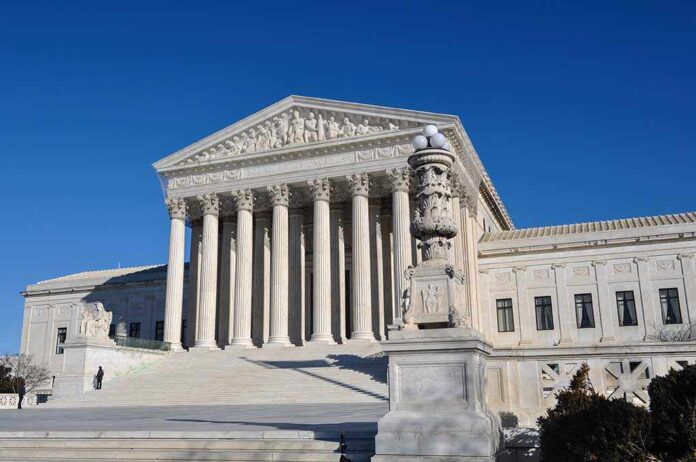
A Supreme Court showdown now threatens to decide whether states can silence faith-based counselors—putting First Amendment protections and parental rights at risk nationwide.
Story Snapshot
- The Supreme Court is set to rule on Colorado’s ban of faith-based counseling for minors struggling with gender identity, a decision that could reshape free speech rights across America.
- Christian counselor Kaley Chiles argues the law violates the First Amendment by forbidding voluntary, religiously-informed counseling, while Colorado claims it protects vulnerable youth.
- The case pits religious liberty and free speech against aggressive state regulation—testing whether government can dictate what licensed professionals are allowed to say.
- A ruling for Chiles could overturn similar bans in more than 20 states, while upholding the law could embolden further attacks on constitutional rights and parental authority.
Supreme Court Considers Limits on Free Speech and Religious Liberty
The U.S. Supreme Court is hearing Chiles v. Salazar, a pivotal case challenging Colorado’s 2019 law banning so-called “conversion therapy” for minors. Kaley Chiles, a Christian counselor, contends the law infringes on First Amendment rights by criminalizing voluntary, faith-based counseling for children questioning their gender, while the state defends its authority to regulate “harmful” professional practices. This case has drawn national attention because its outcome could set precedent for over 20 states with similar bans, directly impacting the future of faith-based counseling and professional free speech.
The law at issue was originally justified by claims from major medical associations that any effort to help minors align with their biological sex is “harmful.” Over the past decade, activist-driven scientific consensus led to bans on conversion therapy in more than 100 localities and 20 states. Yet, these bans have been repeatedly challenged by religious and conservative groups as unconstitutional, arguing such laws impose viewpoint discrimination by silencing only those who dissent from radical gender ideology. The Supreme Court previously refused to hear similar cases, but now—under a conservative majority—has agreed to weigh in, raising hopes for a restoration of free speech and religious liberty in counseling rooms nationwide.
Legal Tension: State Power Versus Constitutional Rights
At the heart of the case lies a profound clash: Does the government have the right to dictate what ideas a licensed counselor may express, especially when those ideas are rooted in religious conviction? Colorado claims its ban merely regulates professional conduct, not speech, and is necessary to protect children from practices deemed “harmful.” However, critics point out that the law specifically targets and censors faith-based viewpoints—while leaving secular, gender-affirming counseling untouched. This, they argue, is classic viewpoint discrimination, forbidden by the First Amendment. Supreme Court justices, particularly from the conservative bloc, have voiced skepticism about such selective censorship, with Justice Alito reportedly calling the law “blatant viewpoint discrimination” during oral arguments.
Despite the Colorado law’s continued enforcement, no therapist has actually been sanctioned under it to date, underscoring the law’s role as a chilling warning to counselors of faith. The pending Supreme Court decision, expected by June 2026, will either reinforce state powers to regulate speech or reaffirm core constitutional protections that shield Americans from government overreach—especially when it comes to parental rights and the freedom to seek counseling in line with one’s faith.
Potential National Impact and Ideological Divide
Should the Supreme Court side with Chiles, conversion therapy bans across more than 20 states could be invalidated, restoring the ability of families and faith-based counselors to address gender confusion through voluntary, private conversations. A ruling in Colorado’s favor, however, would cement the power of progressive states to dictate “acceptable” speech between counselors and clients, further emboldening leftist policymakers to target religious viewpoints in the name of “public health.” The case has already intensified national debates over LGBTQ+ rights, parental authority, and the limits of state power, with major advocacy groups on both sides mobilizing for the final decision. The outcome will have ripple effects across the mental health profession, religious organizations, and American families concerned about government intrusion into sacred personal matters.
The battle lines are clear: one side frames the issue as protecting vulnerable youth, the other sees it as a test case for constitutional freedoms and parental rights under siege. With a conservative Supreme Court majority, many Americans hope this decision will finally halt the steady encroachment on free speech, religious liberty, and the foundational principles that have defined our nation’s moral fabric.
Supreme Court to decide if faith-based counseling on gender identity is protected speech https://t.co/lPyoqE8BO8
— Fox News Politics (@foxnewspolitics) October 7, 2025
While medical organizations and LGBTQ+ advocates warn of potential harms if bans are overturned, constitutional law experts highlight that viewpoint-based speech restrictions—especially on voluntary, faith-driven counseling—are almost always found unconstitutional. The Supreme Court’s ruling will clarify not only the fate of conversion therapy laws, but also the broader question of whether the government can silence dissenting voices and faith traditions under the guise of “protecting” the public. With so much at stake, families, counselors, and advocates are watching closely, knowing the decision will shape the future of free speech and religious liberty for generations.
Sources:
The Washington Times: Supreme Court hear free speech dispute counseling transgender youth
The Daily Record: Supreme Court conversion therapy First Amendment case
Axios: Supreme Court conversion therapy challenge