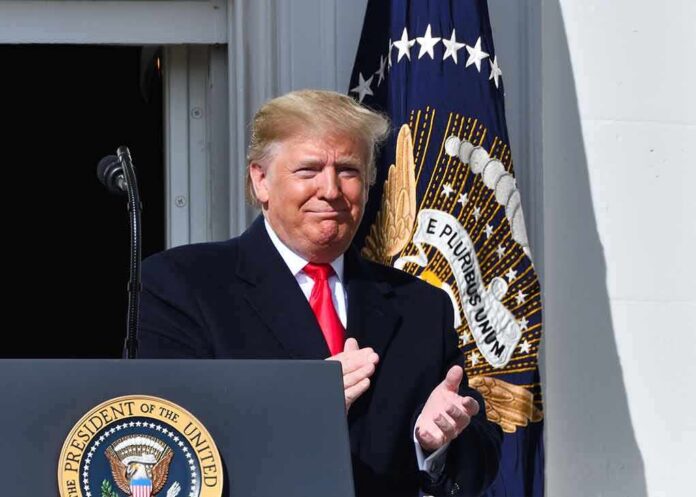
President Trump told reporters in Dublin that a united Ireland “would be a great thing” and said it will happen “eventually,” a comment that jolted a long-running and sensitive constitutional debate.
Story Snapshot
- Trump said he would “love” to see Irish reunification and called it “fantastic.”
- The remark lands in a legal framework where a future vote is possible under the Good Friday Agreement.
- Analysts note the threshold for calling a referendum is unclear and rests with the United Kingdom’s Northern Ireland Secretary.
- Polling suggests support for unity in Northern Ireland has not yet reached a majority.
What President Trump Said In Dublin
President Trump said in Dublin that he “would love to see” Ireland unified and that such an outcome will happen “eventually.” He also called the idea “a great” or “fantastic” thing during public appearances with Irish leaders. His phrasing was direct and upbeat, without the usual diplomatic caveats found in cross-border issues. Those short lines quickly echoed across Ireland and the United Kingdom because they touched a core question about national identity and future borders.
Trump’s past comments in Ireland also leaned optimistic on border questions tied to Brexit and trade. During a prior meeting in Shannon, he said the border issue would “work out” and that outcomes could be “very, very good for Ireland.” Supporters heard confidence. Critics heard a casual approach to a delicate peace. His current remarks continue that pattern: brief statements, sweeping tone, and big reactions across a divided audience.
The Law: How A United Ireland Could Happen
The Good Friday Agreement set a peaceful path for constitutional change. It says people can choose unity through a vote held in Northern Ireland. United Kingdom law places the decision to call such a “border poll” with the United Kingdom’s Northern Ireland Secretary, who must act when it “appears likely” a majority would vote for unity. The law does not define exact triggers or measures. That gap often turns political heat onto each new signal or headline.
That legal design protects consent but leaves room for argument. Advocates for unity point to social change and shifting identities. Unionists point to recent results and caution against rushing a vote that could destabilize daily life and business. Outside leaders who comment on unity can inflame those tensions, even if they do not set policy. This is why Trump’s few lines made waves far beyond the meeting room where he spoke. The rules invite debate when famous voices weigh in.
What Public Opinion Shows Right Now
Recent research and roundups show no clear pro-unity majority in Northern Ireland today. Academic reviews and policy briefs describe limited evidence for a win for unity if a vote were held now. Some polling puts support for unity well below fifty percent, with one study citing twenty-seven percent backing at the time it was conducted. Trends can move, but today’s numbers suggest the “appears likely” test has not been met.
Poll trackers also note that sentiment in the Republic of Ireland is more favorable toward unity than in the North. But the Agreement centers the decision in Northern Ireland. That means island-wide enthusiasm does not trigger the vote. The legal key remains a majority in the North. Until that shifts, British ministers have strong cover to wait, and Irish leaders must balance aspiration with the risk of a failed poll setting unity back.
Why The Remark Resonates In U.S. Politics
Trump’s comment intersects with American views about borders, sovereignty, and elite decision-making. Many voters, on right and left, feel global institutions and distant bureaucrats ignore local consent. The Good Friday framework stands on consent first, which fits that public mood. Yet the vague threshold to call a vote can look like power kept by officials, not people. That tension makes any outsider’s cheer for unity land as more than small talk to those who distrust “the deep state.”
🇬🇧🇮🇪 UK–IRELAND: Prime Minister Andy Burnham says Britain’s position on Irish unity remains unchanged despite Donald Trump backing a united Ireland. #UKNews #Ireland
— Eyeworldnewsdigital (@eyeworldnews444) September 12, 2026
For conservatives who value stability and energy for growth, rapid change in Northern Ireland can seem risky. For liberals who stress rights and identity, self-determination is central. Both camps agree that people on the ground should decide and that leaders should be clear and accountable. Trump’s upbeat tone may feel like a win to some and an oversimplification to others. The real gate remains the law, the data, and the duty to protect peace while letting voters choose.
Sources:
redstate.com, nbcnews.com, reuters.com, trumpwhitehouse.archives.gov, euronews.com, cbsnews.com, presidency.ucsb.edu
© truthandliberty.com 2026. All rights reserved.