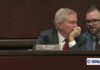
A Georgia jury’s fast guilty verdict against a school shooter’s father is now testing how far the justice system can go in punishing adults for a child’s evil.
Story Snapshot
- Colin Gray, 55, was convicted on 27 of 29 counts after prosecutors argued he ignored glaring warning signs and still provided his son an AR-15-style rifle.
- The September 4, 2024, shooting at Apalachee High School in Winder, Georgia, left four dead—two students and two teachers—and injured nine others, according to reporting.
- The case is described as the first adult charged in connection with a Georgia school shooting and one of only a handful of U.S. cases targeting a parent after a mass shooting.
- Supporters of gun rights are watching closely because the verdict centers on “foreseeability” and alleged negligence—not on pulling the trigger.
What the Jury Convicted the Father For—and Why It Matters
Barrow County jurors convicted Colin Gray after a two-week trial, reaching a verdict in less than two hours, according to published reports. Prosecutors said Gray provided the weapon and failed to act despite warnings that his son, Colt Gray, was mentally unstable and showing fascination with mass shootings. Gray faced 29 counts tied to second-degree murder and other charges, and the jury convicted him on 27 while two counts were dropped.
The constitutional tension here is real: Americans do not want government using tragedy as a shortcut to erode lawful gun ownership. At the same time, this case did not turn on a simple “gun ownership equals guilt” theory; prosecutors focused on alleged, specific negligence—what Gray knew, what he saw, and what he did anyway. That distinction will likely shape how broadly (or narrowly) this verdict is used as a template in future prosecutions.
The Shooting Timeline and the Weapon at the Center of the Trial
Authorities say the attack happened on September 4, 2024, at Apalachee High School in Winder, roughly 50 miles northeast of Atlanta. Colt Gray was 14 at the time and is accused of bringing a semiautomatic AR-15-style rifle to school in a book bag, wrapped in poster board, then opening fire in classrooms and hallways. Two students—Mason Schermerhorn and Christian Angulo—and two teachers—Richard Aspinwall and Cristina Irimie—were killed.
Reporting also indicates eight students and one teacher were injured. The rifle, according to the accounts presented, was a Christmas gift in 2023 from Colin Gray to his son, with conditions that it be used at the range and that the teen maintain good behavior until age 18. Colt Gray, now 16, has been charged as an adult with dozens of counts and has pleaded not guilty, with his trial date not yet set.
What Prosecutors Pointed to as “Red Flags”
Prosecutors argued the father had enough warning to foresee danger. Trial reporting referenced behavior problems and turmoil at home, including property destruction and conflicts, plus indications of obsession with prior mass shootings. One detail that drew attention was evidence that Colt kept a “shrine” to the Parkland shooter. Prosecutors also described notebooks and planning materials, and they framed the father as a key gatekeeper who could have prevented access to a deadly weapon.
The defense pushed back by emphasizing shooter agency—arguing that Colt Gray acted secretly and that the father could not have anticipated the attack. Colin Gray testified that he struggled with what happened and described his son as a “good kid,” while acknowledging he gave him the firearm. The jury’s quick deliberation suggests jurors found the state’s “foreseeability” case more convincing than the defense’s claim that responsibility rests only with the person who fired the shots.
A Precedent Case With Big Implications for Families and Gun Owners
This conviction lands in a narrow but growing category of cases where prosecutors pursue parents after mass shootings involving minors. CBS reporting describes it as the third such U.S. case and the first adult conviction tied to a Georgia school shooting. That precedent matters because it can influence how law enforcement and prosecutors interpret “recklessness” and “endangerment” when a minor gains access to firearms in the home, even absent proof the parent intended harm.
For conservatives who defend the Second Amendment, the key question is whether future cases will stick to extreme, fact-specific circumstances—like alleged ignored warnings and a direct gift of a rifle—or whether activists and ambitious prosecutors will try to stretch the logic to ordinary gun-owning families. The available reporting does not show any new statute at issue here; instead, it shows a jury applying existing criminal charges to a parent’s decisions and omissions in the lead-up to a catastrophe.
What We Still Don’t Know—and What Happens Next
Sentencing for Colin Gray was not included in the available reporting, and the timeline for Colt Gray’s trial remains unclear. The public also does not yet have a full, uncontested record of which warnings were formally documented versus raised informally within the family or community. Even so, the case is already reshaping the debate: it shifts focus from sweeping gun bans toward accountability questions about storage, supervision, and intervention when a minor shows signs of instability.
For readers frustrated by years of political exploitation after national tragedies, this case is a reminder to separate two issues that often get blurred on purpose: enforcing laws against negligence in extreme circumstances versus using grief as leverage to restrict rights for millions of peaceful citizens. The evidence described in court coverage centers on specific behavior, specific warnings, and a specific transfer of access. How narrowly courts keep that standard may determine whether this remains an exceptional verdict—or becomes a broader tool.
Sources:
Jury convicts suspected Georgia school shooter’s father of murder
Colin Gray murder trial verdict: jury update in Apalachee High School shooting case