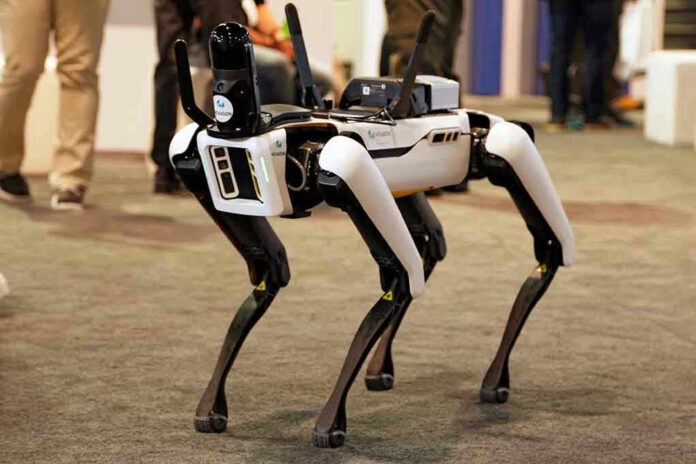
A Chinese-made “robo-dog” armed with a high-powered water cannon is now being deployed for firefighting—raising urgent questions about American innovation, national security, and the future of first responders.
Story Highlights
- Unitree B2, a $150,000 Chinese quadruped robot, is now equipped for firefighting, touting advanced mobility and a 60-meter water/foam cannon.
- The B2 has completed drills with Chinese firefighting teams, signaling a major leap in robotic emergency response—but no U.S. deployments are reported.
- Experts warn of potential workforce displacement, reliance on foreign tech, and unanswered questions about operational reliability in real-world disasters.
- While the B2 could reduce firefighter risk, its high cost and Chinese origins spark concerns about American competitiveness and security in critical infrastructure.
Technological Leap or Strategic Vulnerability?
The Unitree B2 represents a significant advance in robotics, moving beyond surveillance and inspection to active firefighting roles. Its modular design allows mission-specific customization, while a high-powered water/foam cannon (60-meter range, 40 liters per second) and superior mobility (climbing 15-inch obstacles, 45-degree stairs) enable it to tackle fires in environments too dangerous for humans. Hot-swap batteries and autonomous features like hose detachment and self-cooling further distinguish the platform, which has already joined official firefighting teams in China, notably in Qingdao.
While the B2’s capabilities are impressive, its Chinese origins and rapid adoption overseas highlight a troubling trend: American firefighting technology risks falling behind foreign competitors, even as U.S. cities face growing threats from wildfires and industrial accidents. The absence of similar domestically developed platforms raises questions about U.S. investment in critical emergency technologies and the potential security risks of relying on foreign-made systems for essential public safety functions.
Impact on First Responders and Communities
The immediate benefit of robotic firefighting is clear: reducing human exposure to life-threatening conditions. Firefighters face significant risks in urban and wildland blazes, and the B2’s ability to operate autonomously in hazardous zones could save lives and improve response times. In the long term, widespread adoption could reduce injuries and fatalities among first responders, while also transforming fire response protocols and setting new industry standards for modular, mission-specific robotics.
However, the economic and social implications are complex. The B2’s $150,000 price tag—while competitive for advanced robotics—represents a substantial upfront cost for cash-strapped municipal budgets. Potential savings from reduced injuries and property loss must be weighed against the risk of workforce displacement and the challenges of integrating robots with human teams. Public trust in technology for safety may rise, but so could concerns about job security for American firefighters and the reliability of autonomous systems in unpredictable, high-stakes emergencies.
Broader Industry and National Concerns
The B2’s emergence accelerates global competition in robotics for hazardous environments, with Chinese firms like Unitree now leading in affordability and adaptability. This stands in contrast to U.S. offerings such as Boston Dynamics’ Spot, which lacks integrated firefighting capabilities. The B2’s real-world deployment in China sets a benchmark that American manufacturers and policymakers cannot afford to ignore, especially as wildfires and urban fires grow more severe due to climate and infrastructure challenges.
From a conservative perspective, the rise of foreign robotic firefighting platforms underscores the need for renewed focus on American innovation, domestic manufacturing, and secure supply chains for critical infrastructure. Relying on Chinese technology for essential emergency services could expose U.S. cities to geopolitical risks, including potential espionage, supply chain disruptions, or embedded vulnerabilities. At a time when the Trump administration has prioritized “America First” policies and revitalizing domestic industry, the B2’s success abroad should serve as a wake-up call for U.S. investment in next-generation emergency technologies.
Expert Perspectives and Unanswered Questions
Industry analysts praise the B2’s mobility and modularity, noting its advantages over existing platforms. Robotics researchers emphasize the importance of robust, adaptable systems for emergency response, while fire safety professionals caution that operational reliability and seamless integration with human teams remain unproven in large-scale, unpredictable disasters. Some experts question whether such robots are ready for primetime, or if their deployment could lead to overreliance on technology at the expense of skilled personnel.
For American conservatives, the story of the B2 is not just about technological progress—it’s a test of national priorities. Will the U.S. cede leadership in critical public safety technologies to foreign competitors, or will it reinvest in homegrown innovation, secure supply chains, and the men and women who keep our communities safe? The answer will shape not only the future of firefighting, but also America’s standing in the global race for technological supremacy.
Sources:
Unitree B2 Robotic Dog Gets Promoted to a Firefighting Job With Upgraded Hardware – Yanko Design
Unitree B2 Fire Rescue Robot – New Atlas
Unitree B2 – Unitree Robotics Official Site
Boston Dynamics Spot – Boston Dynamics Official Site